
Pavement parking is a daily reality for disabled people, older people, children and parents with pushchairs across Oxfordshire. On Tuesday 17th November, representatives from OLS and CoHSAT went to County Hall to speak in support of the Cabinet Response to Council Motion on Pavement, Path and Verge Parking, brought by Cllr Laura Gordon. Cabinet went on to approve the response. Here’s what we said, and what it means for the people living with it.
Danny Yee, representing OLS, called for Cabinet to aim for as close to a no exemptions policy as possible, with double yellow lines where vehicles genuinely need access. He pointed to Edinburgh, where a ban with no exemptions needed yellow lines on two streets at first and around ten places in the longer term.
OLS Managing Director Siobhann Mansel-Pleydell spoke to the impact pavement parking is already having on disabled people, older people, children and parents with pushchairs, every day across the county.
Almost three in ten people who took part in Future Streets Oxfordshire are disabled, and four of the seven groups in the first workshop raised pavement parking, unprompted, as a key issue in their street or neighbourhood.
“People told us about not being able to leave the house on a mobility scooter because of obstructions, or having to turn back, pushchairs forced into the road. And when 120 people tested the draft community-led indicators, the strongest response was to this indicator: “people feel safe and confident getting around their neighbourhood, whether they’re walking or wheeling. 119 out of 122 said “yes, I want this in my place
”
With parking demand so high, she said, the pressure on pavements won’t shift without alternatives in play. Siobhann called for options such as car clubs, cycle hangars and secure cycle storage to sit alongside enforcement, reinforcing the need for work on a Kerbside Strategy to start sooner rather than later.
Damian Haywood, former County Councillor and Director of Oxfordshire Liveable Streets, who cares for his severely disabled wheelchair-bound son, said:
“A car on the pavement isn’t just an inconvenience for us. It’s a daily battle. Every time I go out with Matias, I’m working out how to get him past parked cars, and quite often the answer is the road. It’s unsafe and, quite frankly, exhausting for both of us, having to navigate it day in, day out. We desperately need clear rules and strong enforcement, and that day can’t come soon enough for me and Matias.”
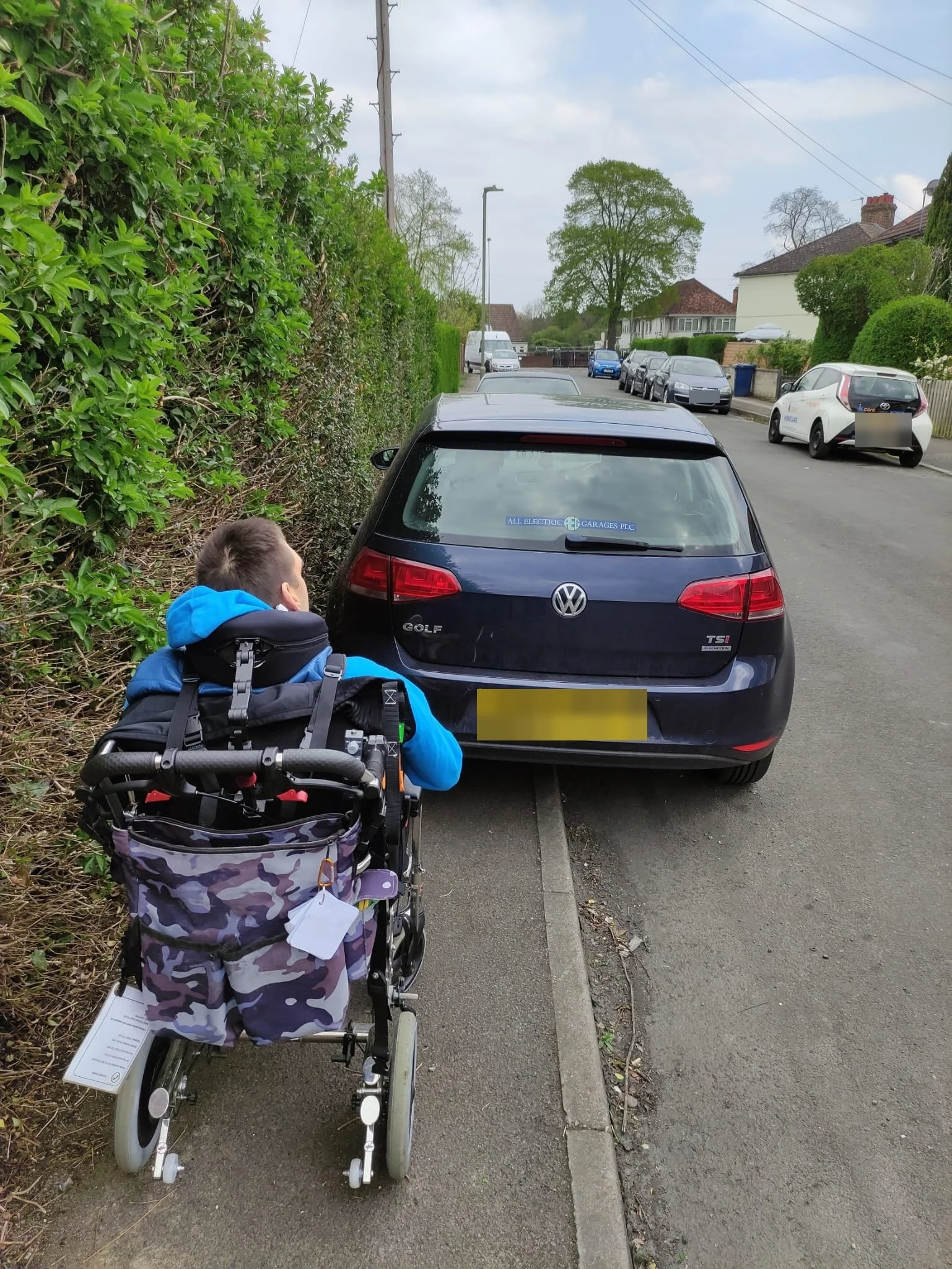
A car parked on the pavement leaves no way through. Photo: Damian Haywood
On the same day, the Banbury Guardian reported that disabled residents of Hook Norton, a village near Banbury, have raised concerns over inadequate pavements and parked cars. Cars parked over footpaths are stopping people on mobility scooters, and families with pushchairs, from getting around. One resident described a dropped kerb on the High Street where “you can guarantee there is a car blocking it”.
Robin Tucker of CoHSAT spoke to the motonormative assumptions that drive pavement parking.
“We have a problem. Cars and vans dominating our roads and streets. Killing more than a thousand people through crashes in Britain every year. Thousands more from pollution. Thousands more from induced inactivity. And gradually they are creeping on to our pavements, the last safe place for people.
”
“Our pavements, paths and verges are the most basic mobility facility remaining,” he said, “and yet attempts to defend even these from encroachment are attacked as ‘anti-motorist’ or a ‘war on cars’.”
Councillors across the chamber backed the direction of travel. Cabinet Member for Transport Cllr Gareth Epps described it as “a major inequality issue, not an infringement of motorists’ rights”, and noted that officers can’t do much until secondary legislation and regulations arrive. He said, “Oxfordshire needs a policy that works for rural and urban areas, and one that covers enforcement”.
Cllr Neil Fawcett, Deputy Leader and Cabinet Member for Resources, said “the vast majority of people want to see pavements free for everyone”, and that the council should be “fully prepared to protect them as soon as the regulations come through”.
Leader of the Council, Cllr Tim Bearder will write to national government to ask when the powers are coming, what support there will be to implement them, and what is needed to make enforcement effective.