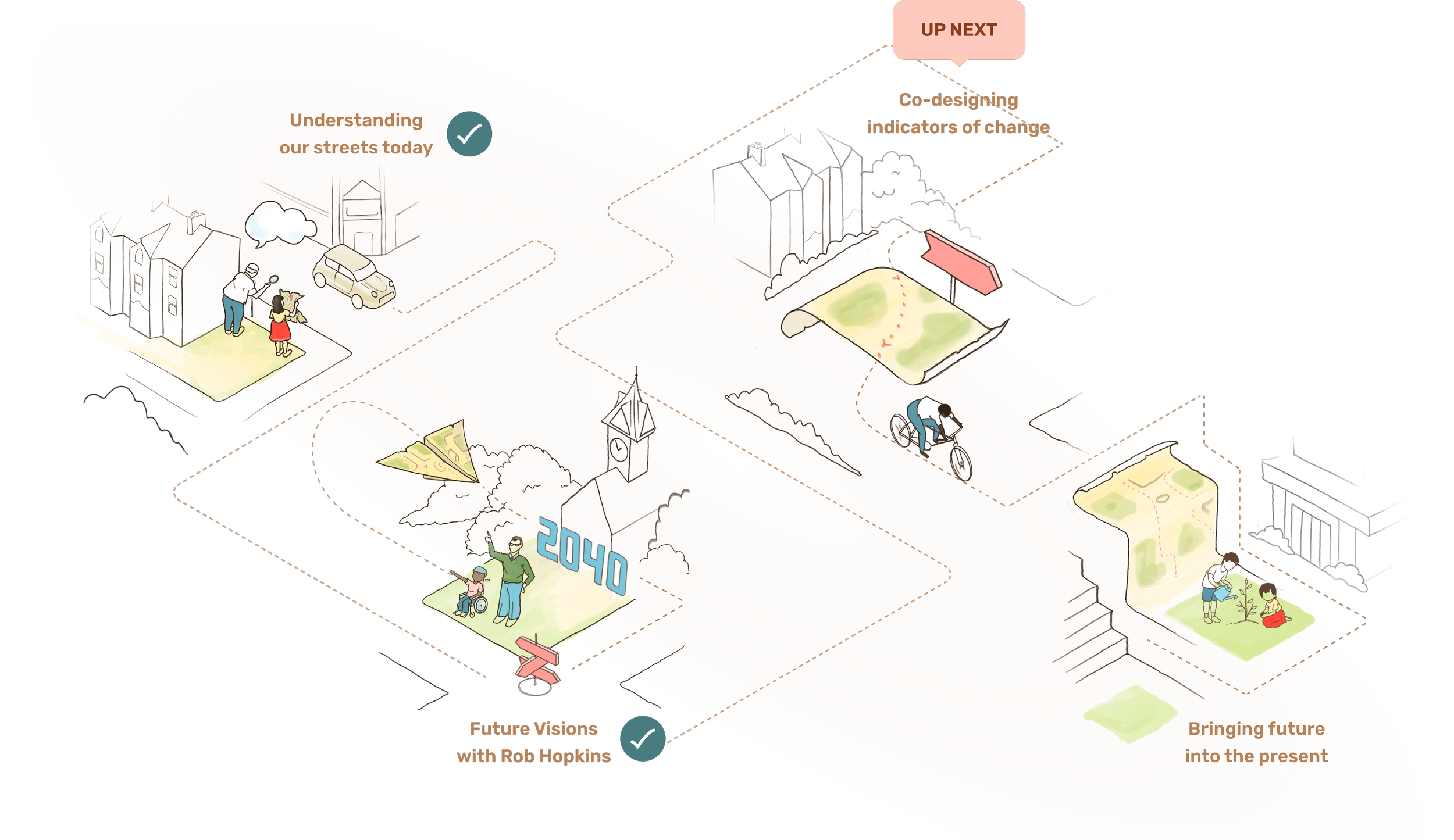

About Workshop 1
On the evening of 24th March, nearly 50 people from across Oxfordshire joined us online for the first Future Streets workshop. A reminder of our starting point for this series, and workshop 1 : that streets and neighbourhoods could support more people to really thrive. But what does that actually mean in Oxfordshire? Peter Lefort facilitated a session that moved between personal reflection and systems thinking, unpacking what matters most, what needs to change, and what the idea of thriving in our places means for those who live here.
Participants were asked what they want to hold onto about their streets and neighbourhoods, what they'd let go of, what's missing, and what they'd keep away.
Following the scheduled workshop, we floated a survey for the people who really wanted to come but couldn't, and for those who needed a quieter, more flexible way to take part. Thanks to Marwa at Integrate CIC, we also hosted an additional community conversation at The Barn in Blackbird Leys. All were asked the same questions.
Responses were carefully reviewed and thematically analysed by our team, with the support of a Large Language Model to help cluster the volume of contributions and bring objectivity to the process. Ongoing human checks ensure the accurate representation of everyone's responses. Below are the prominent themes of what people value, hope for and fear about in their streets and neighbourhoods.
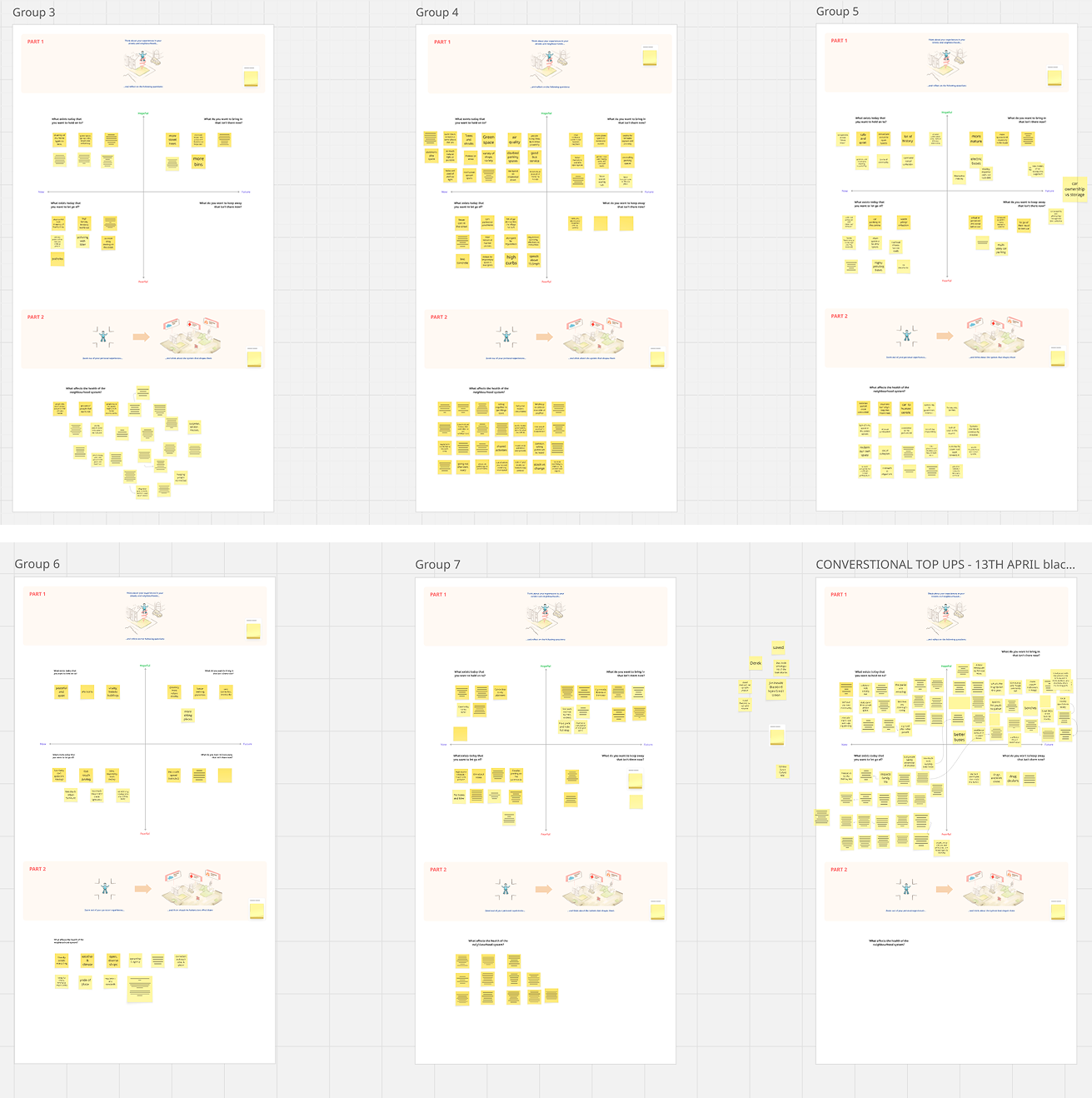
Img 1. Screenshots from the Miro board after Workshop 1
The Big Picture
and how it fits in our process
Workshop 1 helped us understand the present system and what people’s hopes and fears are.
The insights from workshop 1 were shared with the participants to ensure everyone’s ideas are represented. In workshop 2, we worked on shared visions and “what-if?” questions for how our streets and neighbourhoods should work. Through more workshops and repeated feedback, this would help us create the stories of change from our current state to a desired one.
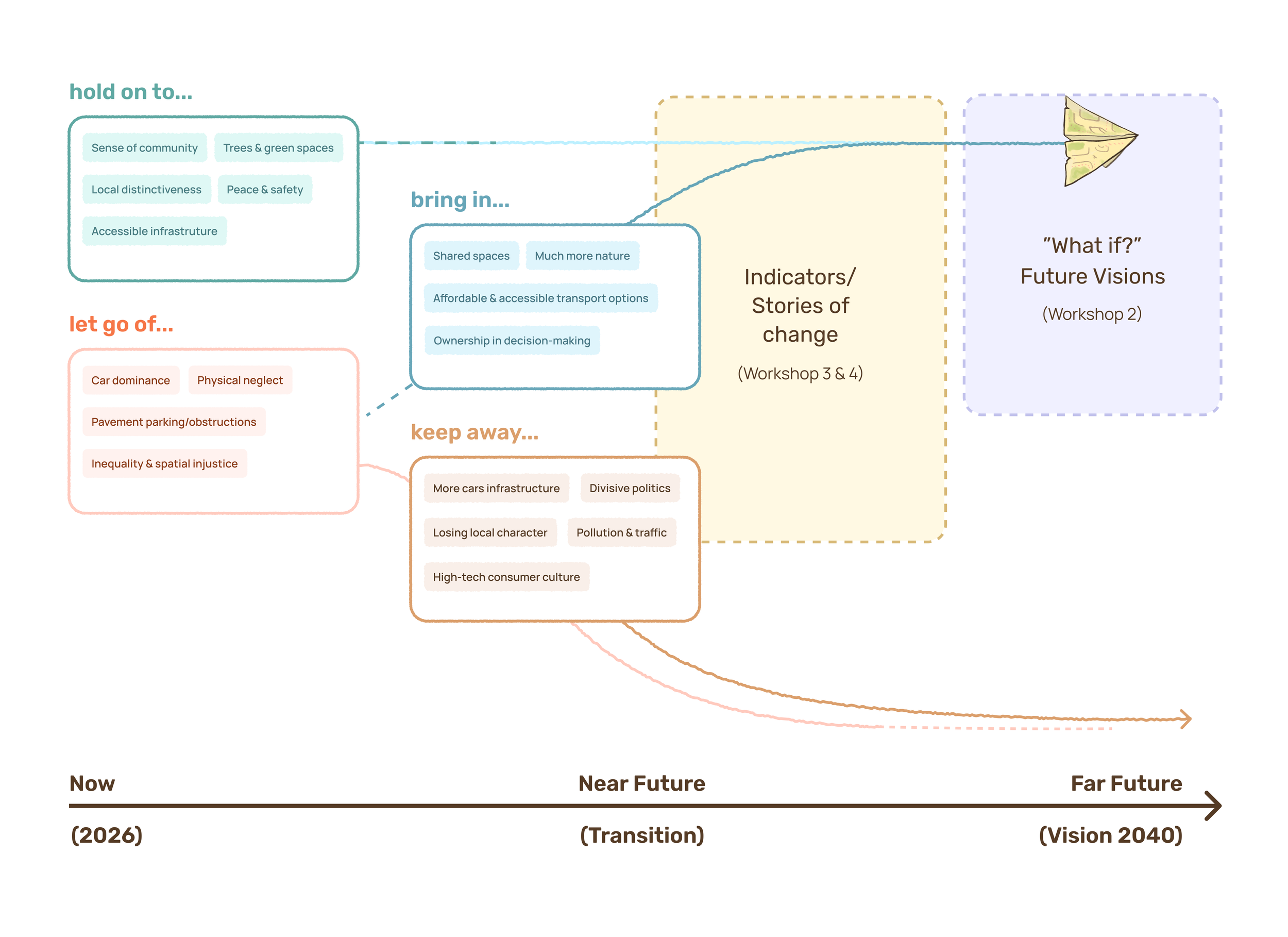
Img 2. A visualisation of our process inspired by the three-horizons map
Key Insights
The core clusters that have emerged so far are; social cohesion, nature and environment, local identity and character, accessibility and equity, mobility and traffic.
Below are examples of the comments across these core clusters. These areas will become the foundational dimensions for the community-led indicators that emerge from this process. The clusters have been entirely determined by participant responses.
People wish to hold on to...
A felt sense of community and cultural diversity in the streets
"Community groups that support people like the hub"
"Held a street party — amazing diversity + food from all over the world"
"LTN quietness enables talking to neighbours and kids playing in the street"
Trees and green spaces as a way of allowing wildlife to prosper
"Hedgerows instead of fences that help maintain wildlife networks"
"Sounds of birds not getting drowned by traffic volume"
"Walkability — interaction with wildlife"
Local distinctiveness and diversity — the character that makes streets feel like their own
"Local small businesses", "Independent traders", "Variety of shops"
"Historical buildings", "Victorian conservation area", "Diversity of the homes"
Neighbourhoods being safe and peaceful — welcoming of everyone
"Multicultural diversity is a strength for Blackbird Leys"
"Tolerant of people from various backgrounds"
"Low speed on residential street"
Existing accessible infrastructure that eases living in neighbourhoods
"Various ways to sit near the bus stops — grassy benches"
"Good bus service", "Disabled parking spaces", "Pedestrian areas"
"Like the leisure centre — need it to be strong and can't travel as much"
People wish to let go of...
Cars and large speedy vehicles dominating street life
"Traffic, cars, congestion, traffic fumes, speeding cars"
"Feel dependent on (my) own car"
"High volume exhausts — major noise pollution"
Pavement parking and obstruction, which makes walking difficult — especially with buggy or mobility aid
"Pavements cluttered by cars"
"Cycling on the pavement"
"Narrow and uneven pavements", "Potholes"
The physical neglect all around that makes streets feel uncared for
"Lack of care for shared spaces", "Derelict properties", "Wasteful mindset"
"Waste piling up before collection"
"Fear of sewage in river"
Disregard for laws and rules that help regulate shared spaces for all
"Unregulated delivery firms", "Disrespect for traffic laws"
"No cycling signage not enforced"
"(Speeding) e-bikes operating as motorbikes"
Inequality and spatial injustice in how neighbourhood improvements are distributed
"LTNs get clean air, council estates on the main roads bear the displaced traffic"
"Too much reliance on food banks. Shouldn't need them in the 21st Century"
"Equitability/fairness", "Balancing local needs vs the wider utility needs"
People wish to bring in...
Shared spaces, especially in less affluent areas, where they are a necessity for community strength
"Somewhere to gather for free outside with more than one person"
"Posher places do street parties, we want them too"
"More sitting places", "Community gardens"
Much more nature woven into everyday spaces because streets currently feel too hard and grey
"More street trees", "Wild verges for bees", "Community food production", "Swales"
"Green spaces in residential streets"
"Somewhere to sit and look at greenery"
Affordable, unified public transport across towns in Oxfordshire
"Better bus routes between Oxfordshire towns", "Better bus routes to city centre"
"Community bus service to key amenities"
"I can't afford taxis.. we lost the number 12 and that was a perfect bus service"
Infrastructure that allows for greater freedom of movement for all
"Gentler, more user-friendly kerbs for people with impaired mobility"
"More ramps and lifts and step free access outside of the centre of Oxford"
"Free park and ride for NHS workers"
More ownership and collaboration among local communities in decision making and fund usage
"Local people with the wisdom to be empowered to make decisions"
"Local money spent more wisely"
"Need money spent on getting people out and together"
People wish to keep away...
More car infrastructure from replacing what remains
"Houses with front gardens replaced by parking lots"
"Development that changes green spaces"
"Overdevelopment without planning"
Divisive politics and threats to the inclusive, diverse community
People want to let go of a system that pits neighbours against each other
"Racism needs to stop."
"Far-right nationalism"
Losing local character to chain stores or institutional takeover eroding social mix
"Chain stores replacing independents"
"Dorms and student accommodation displacing ordinary housing"
High tech consumer culture that would erode the street life and local economy they care about
"Drones for delivery"
"I've heard about how food delivery robots are a nightmare to navigate as a wheelchair user. So I don't want them on our streets"
Pollution from traffic — fumes, smog, rat runs, causing health risks
"Continued pollution-heavy transport systems"
"Not having millions of cars pass through my street"
Biggest Echoes
So far, these are the biggest echos across responses but we still have a lot more to process following Workshop 2. Bear in mind that currently nothing is fixed and everything is still in emerging.
People want safe and accessible streets, coupled with well-connected transport across towns
Public transport comes through as a genuine priority, framed around freedom of movement and accessibility. Walkability matters too: wider pavements, seating along routes, and more accessible kerbs for people with impaired mobility.
Community life depends on shared physical places and rituals that are accessible to all
There is a deep appetite for social connection: knowing your neighbours, children playing outside, places for chance encounters, and community groups supporting each other were voiced as necessities.
People value green spaces as infrastructure to co-exist and thrive with nature
Green space and nature feature in almost every response, not as a luxury but as something people feel the absence of: trees, wild verges, birdsong, community growing spaces, hedgerows that double as wildlife corridors.
Streets are designed for cars, but people want to live in them — longing for a sense of community
A dominant thread in all discussions was car dominance: the volume, the noise, the fumes, and the space taken up by parked and moving vehicles. People valued freedom of talking to neighbours and kids playing in the streets.
Those left out of decisions impacting neighbourhoods have to navigate the gaps
Public space works best when the people who use it help shape it. Across the workshop, those with least representation in planning decisions — in council estates, with mobility needs — described streets that didn't account for them.
Be a part of this journey