
What if we could time travel to the future? And what if, when we got there, we found streets and neighbourhoods exactly as we needed them to be?
Over the course of 2026 we have been inviting people from across Oxfordshire to co-create a vision of thriving streets and neighbourhoods - and explore the practical pathways to bring this vision to life.
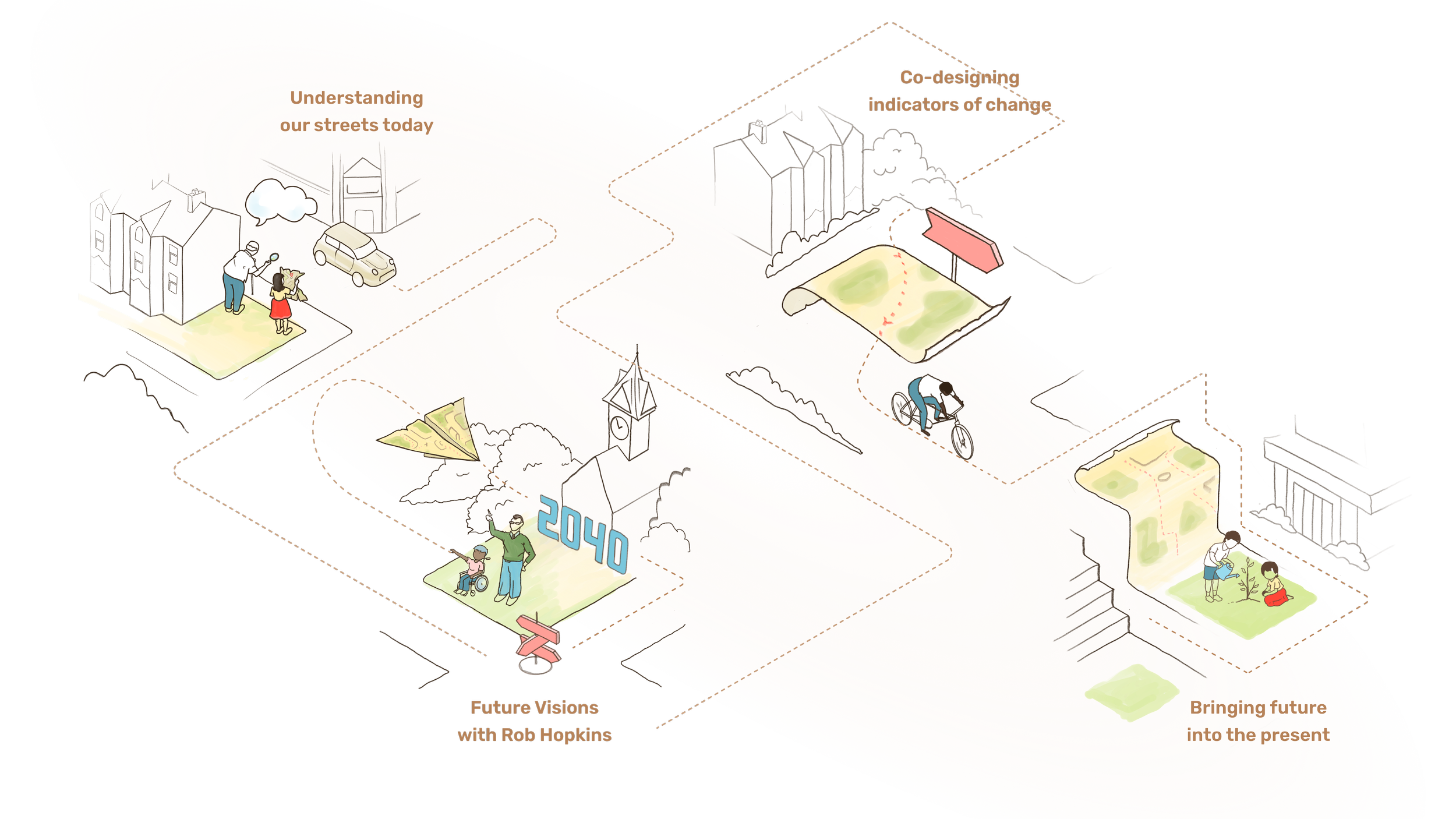
Through four workshops between March and June, we:
Grounded ourselves in where we are now to understand what what people loved most about their streets and neighbourhoods, what people longed for and, critically, what they wanted to let go of. Read more here.
Time-travelled to imagine what thriving streets could look and feel like with futurist Rob Hopkins. Read more here.
Co-designed community-led indicators of change. Check out the latest here
And in the Autumn, our fifth and final workshop will take place where we will consider the enabling conditions needed to support the kind of changes people want to see in their places - what can we start doing now, to bring this future into the present moment?
This has been an iterative process of participatory design with each workshop informing and building on the last. Some people attended one, and others attended several, and the current draft indicators continue to reach people who haven’t been able to take part of the workshops. The draft indicators are currently out for some light-touch resonance testing to play the work so far back to participants, residents, and stakeholders.
This graphic unpacks the journey.
About the Project
Councillors and officers
A community-led vision builds the evidence base and democratic mandate for policy. This project builds on the work of the Citizens' Assembly with a place-based, bottom-up vision and co-authored indicators of change that give communities — and representatives of local government — a shared language for what success looks like.
Young people (12+)
This is about futures you'll inherit, and decisions being made now will shape them. Your participation ensures youth priorities - safe routes to school, clean air, spaces that actually work for young people - get embedded in what we advocate for. We'd love young people at every workshop, especially the full-day Time Travel experience with Rob Hopkins. We're happy to liaise with Head Teachers and Tutors to enable participation.
Civil society campaigners and community organisers
Our streets and neighbourhoods intersect with multiple systems - from health equity to climate adaptation, early years development to ageing in place, nature recovery to community wealth building. Your involvement brings tangibility to common ground and could unlock new ways to partner and collaborate. The shared vision and indicators become tools you can use in your own advocacy - whether that's making the case to funders, finding allies for campaigns, or demonstrating community support for change. What we build together can strengthen all our work, not just OLS's.
LGBTQ+ People
Safe, welcoming public spaces matter for everyone, but not everyone experiences streets the same way. Your insights on what makes streets feel inclusive, accessible, and safe will shape the vision and indicators - ensuring we're advocating for neighbourhoods where everyone belongs, not just some.
Citizens and residents
Whether you're a parent, an elderly person, an active travel enthusiast, a bus user, or car-dependent and frustrated by limited options, your everyday experience of streets matters here. Your voice and your contributions will shape the future vision, indicators, and play a vital role in working out how we make some of this a reality.
Disabled people
This is co-design from the start, and your lived experience shapes what thriving looks like. Your insights will directly inform the vision and indicators, which means your needs become embedded in what we advocate for - whether that's policy, programmes, infrastructure, or street design standards. Whilst we already do that, the difference in locally-led co-design, is local voices give democratic weight and tangibility to the recommendations.
People from ethnic minorities
We're working to ensure this vision genuinely reflects all of Oxfordshire, and your perspective shapes that. Your participation prevents the vision becoming another well-meaning project designed by and for one demographic. The indicators and priorities you help shape become what OLS advocates for in policy, planning, and funding decisions - ensuring equity is embedded from the start.
Business owners
Evidence shows local economies thrive when businesses are accessible and connected with attractive spaces for lingering and socialising. Your participation will help shape a vision for streets and neighbourhoods that support thriving local economies - ensuring the business case is grounded in what you know works.
Who is this for?
Citizens and residents
Whether you're a parent, an elderly person, an active travel enthusiast, a bus user, or car-dependent and frustrated by limited options, your everyday experience of streets matters here. Your voice and your contributions will shape the future vision, indicators, and play a vital role in working out how we make some of this a reality.
Disabled people
This is co-design from the start, and your lived experience shapes what thriving looks like. Your insights will directly inform the vision and indicators, which means your needs become embedded in what we advocate for - whether that's policy, programmes, infrastructure, or street design standards. Whilst we already do that, the difference in locally-led co-design, is local voices give democratic weight and tangibility to the recommendations.
People from ethnic minorities
We're working to ensure this vision genuinely reflects all of Oxfordshire, and your perspective shapes that. Your participation prevents the vision becoming another well-meaning project designed by and for one demographic. The indicators and priorities you help shape become what OLS advocates for in policy, planning, and funding decisions - ensuring equity is embedded from the start.
Business owners
Evidence shows local economies thrive when businesses are accessible and connected with attractive spaces for lingering and socialising. Your participation will help shape a vision for streets and neighbourhoods that support thriving local economies - ensuring the business case is grounded in what you know works.
Councillors and officers
A community-led vision builds the evidence base and democratic mandate for policy. This project builds on the work of the Citizens' Assembly with a place-based, bottom-up vision and co-authored indicators of change that give communities — and representatives of local government — a shared language for what success looks like.
Young people (12+)
This is about futures you'll inherit, and decisions being made now will shape them. Your participation ensures youth priorities - safe routes to school, clean air, spaces that actually work for young people - get embedded in what we advocate for. We'd love young people at every workshop, especially the full-day Time Travel experience with Rob Hopkins. We're happy to liaise with Head Teachers and Tutors to enable participation
Civil society campaigners and community organisers
Our streets and neighbourhoods intersect with multiple systems - from health equity to climate adaptation, early years development to ageing in place, nature recovery to community wealth building. Your involvement brings tangibility to common ground and could unlock new ways to partner and collaborate. The shared vision and indicators become tools you can use in your own advocacy - whether that's making the case to funders, finding allies for campaigns, or demonstrating community support for change. What we build together can strengthen all our work, not just OLS's.
LGBQT+ People
Safe, welcoming public spaces matter for everyone, but not everyone experiences streets the same way. Your insights on what makes streets feel inclusive, accessible, and safe will shape the vision and indicators - ensuring we're advocating for neighbourhoods where everyone belongs, not just some.
Thinking about how our streets and neighbourhoods could be different is about human relationships, about how we work together, who has the power to shape decisions, and whose knowledge is ‘in the room’.
Here's what we know: people across Oxfordshire share common ground. A desire for places that are a joy to live in, streets where you feel safe and can get around however you need to, where the air is clean, there's space for nature, and where children and neighbours can move freely.
But we haven't stopped to articulate what that looks like together. And it’s really difficult to picture what we don’t know yet without taking the time to really stop and imagine for a moment.
That's where Future Streets begins - combined with genuine curiosity about what becomes possible when responsibility is held in relationship across citizens, local government, businesses, civil society and community leaders.
Why are we doing this?
Workshop format: Each session has been facilitated and designed to be accessible, welcoming and participatory. People work with others through discussion, creative activities, and collective sense-making.
Participation support: We recognised that people are contributing valuable time and expertise. Stipends were available to help cover costs like childcare, transport, or time off work.
Time commitment: Most workshops ran for 90 minutes. Workshop 2 (with futurist Rob Hopkins) was a full day in central Oxford.
Accessibility: Online workshops remove travel barriers. In-person will be in central, accessible venues with refreshments provided.
Participation style: This isn't consultation - it's co-creation. People worked with insights from previous workshops and their input directly shaped where we are now.
Human connections: All workshops, whether online or in person, were carefully designed to create opportunities to exchange ideas, hear other viewpoints and make genuine connections with other members of the community, either close to home or further afield in Oxfordshire.
What happened in the workshops?
What change might come of this?
Honestly? We don't know yet. And that's a healthy place to start - there's not much point going into something if the outcome is already decided.
What we will create:A final report synthesising the workshop outputs — the vision, the indicators, the enabling conditions — will be published and shared with all participants. And the vision and indicators that emerge will directly shape OLS's advocacy priorities, policy asks, and campaigns. Your voices won't just inform our work — they will become the foundation of it.
What each part of the series is designed to unlock:
A co-created vision can act as a north star - a shared reference point to guide new ways of working together, ideas for programmes, collaborations, funding, policy, and advocacy. It expands what feels politically and practically possible. This vision in our work, with your voices at the heart of it, will guide the important work we do.
Community-led indicators help us communicate what we're working toward in human terms, not just data. We refer to them across these pages as ‘signals of change’ but they can also represent the new narratives we’re working toward. They can sit alongside institutional or municipal metrics and indicators, and give communities and decision-makers ways to envisage and track change at the hyper-local scale. These become tools for holding decision-makers accountable to community priorities. Increasingly, too, local governments are incorporating and adopting community-led indicators and metrics in their own frameworks
Enabling conditions: Workshop 5, the final in the series, is where it all comes together and is specifically designed to unlock the 'how'. This in-person session is built to bring residents and community voices into the room alongside the people with the power to act — local officials, planners, funders, businesses. What gets unlocked here, we hope, becomes the foundation for practical action that outlasts the project itself.
The outcome we can plan for but not predict is what happens when diverse voices come together. When people who wouldn't normally be in the same conversation meet, unexpected things emerge. Ideas that none of us would have arrived at alone. There’s also a sense of agency that comes from sharing ideas and co-creating together. This isn’t an ‘outcome’ that’s easy to log or measure, but an experience that stays with people and creates its own ripple effects.
Citizen Architects
Elisa Engel and Katherine Leat of Citizen Architects lead on participatory design that centres community voice and navigates power dynamics with care. Citizen Architects specialises in participatory processes for social change. Elisa and Katherine bring 20+ years' experience creating inclusive engagement in complex public-sector contexts, bridging communities and institutions.
Peter Lefort
Expert facilitator and systems thinker who makes complex systems legible through playful, structured methods. Peter works across diverse frameworks including Doughnut Economics and Positive Tipping Points and will help design and deliver workshops.
Suyash Sinha
Designer and futures thinker (MA Design Futures, Royal College of Art) interested in public systems, social equity, and how public engagement enables systems change. He's the connective tissue that makes sense of insights across the Future Streets workshop series with design thinking.
Rob Hopkins
Co-founder of Transition Network and author of 'How to Fall in Love with the Future: a time traveller's guide to changing the world'. An Ashoka Fellow and TED speaker, Rob pioneered the Time Travel methodology - immersive collective imagination practice that helps communities perceive different futures. He's facilitating Workshop 2, where participants will journey to 2040 to envision thriving neighbourhoods.
Richard Carman
Architectural illustrator working in watercolour, ink and crayon to bring places and ideas to life. With a background as an architect and extensive experience in public consultations, Richard is adept at working live - capturing and translating emerging ideas as they develop. He'll be providing live illustration during workshop 2 and creating visual documentation of the futures we imagine together.
Who is involved?
Oxfordshire Liveable Streets is leading the project with Siobhann Mansel-Pleydell as strategy and project director, supported by the OLS board. We've built a unique collaboration architecture bringing together specialists in participatory design, futures thinking, facilitation, systems change and visual documentation - each contributing expertise to create a genuinely inclusive, responsive process that creates space for emergence.
Citizen Architects
Elisa Engel and Katherine Leat of Citizen Architects lead on participatory design that centres community voice and navigates power dynamics with care. Citizen Architects specialises in participatory processes for social change. Elisa and Katherine bring 20+ years' experience creating inclusive engagement in complex public-sector contexts, bridging communities and institutions.
Peter Lefort
Expert facilitator and systems thinker who makes complex systems legible through playful, structured methods. Peter works across diverse frameworks including Doughnut Economics and Positive Tipping Points and will help design and deliver workshops.
Suyash Sinha
Designer and futures thinker (MA Futures Design, Royal College of Art) interested in public systems, social equity, and how public engagement enables systems change. He's the connective tissue that makes sense of insights across the Future Streets workshop series with design thinking.
Rob Hopkins
Co-founder of Transition Network and author of 'How to Fall in Love with the Future: a time traveller's guide to changing the world'. An Ashoka Fellow and TED speaker, Rob pioneered the Time Travel methodology - immersive collective imagination practice that helps communities perceive different futures. He's facilitating Workshop 2, where participants will journey to 2040 to envision thriving neighbourhoods.
Richard Carman
Architectural illustrator working in watercolour, ink and crayon to bring places and ideas to life. With a background as an architect and extensive experience in public consultations, Richard is adept at working live - capturing and translating emerging ideas as they develop. He'll be providing live illustration and creating visual documentation of the futures we imagine together.
Would you like to get involved?
Workshops are now complete and the draft indicators are now out for resonance testing. Step into the time portal and travel to Oxfordshire in the near future where streets and neighbourhoods are thriving!