
Why Oxfordshire Needs a Kerbside Strategy
This blog is for anyone with a stake in the kerbside: residents, businesses, community groups, councillors and the officers who make it all work.
Here at OLS we’re responding to another round of CPZ consultations. Top line: they’re much better! The council is listening and responding, and we tip our hats to the officers juggling competing priorities. But here’s the rub. We’ve been here before. Deciding how to allocate space is a head-scratching undertaking that happens every. single. time. In this blog, we make the case for a Kerbside Strategy for Oxfordshire. It’s time for a conversation.
Read to the end: we’ve got an invitation for you, and some links.
What is the kerbside?
Kerbside. What even is it? Is it road? Is it street? Is it the bit next to the road? And why are we dedicating a whole blog to it? Let’s start with the basics.
Roads are about getting people places. Think A-roads, B-roads and motorways. Their job is movement, and success is measured by how smoothly and quickly traffic flows.
Streets, on the other hand, are spaces for people. A street is where the carriageway meets the kerb, the pavement, and the front gardens and doors of our homes. It’s the whole thing. It’s movement, yes, but it’s also where people meet, live, shop, play, sit and gather. A common shorthand is that roads connect places, and streets are places.
If you think of streets as space for cars to drive down and park on, this requires a real shift in mindset. Recommended reading at this point is Jane Jacobs, who described life on city streets as a kind of ballet, “in which the individual dancers and ensembles all have distinctive parts which miraculously reinforce each other and compose an orderly whole”.
She was describing the intricate web of everyday street life. The same thinking runs through the UK’s Manual for Streets (2007), which made the case for inclusive design that put choice, flexibility, and, wait for it, joy into the heart of the thinking.
So where does the kerbside fit? The kerbside is the strip of public space between the pavement and the moving traffic. People have argued about whether streets should prioritise movement, parking or environmental quality since the 1960s. But the idea of the kerbside as a public asset to be planned and shared out is much more recent.
And we can see why. How we move is changing, and it needs to.
Kerbside as contested space
So who has a claim on this increasingly precious public asset? The local restaurant owner who’d like to put tables outside, while leaving room for pedestrians and wheelchair users. The children who want to bike or scoot to meet their mates in town, and need somewhere secure to lock up. All of us, as our streets get hotter, looking for somewhere to rest in the shade of a tree. Tradespeople loading and unloading. Delivery riders on motorcycles. Blue badge holders who need to park close by. Every one of these is a legitimate claim.
Let’s come back to Oxford, where a culture shift is playing out. Around a third of Oxford households have no car. Some choose not to own one, for lifestyle, health or climate reasons. Some simply can’t afford one. For many it’s a mix of both. Cycling has taken hold, and we don’t just mean middle-aged men in lycra. Children cycle to school, families use cargo bikes for the weekly shop, and e-bikes and scooters are now a mainstream way to get around the city. Many are buying into car sharing models instead of ownership. And whether we walk or wheel, we are all pedestrians at some point. The press love to sort people into “motorists”, “cyclists” and “bus users”, but most of us are all of these at different times. How we move is fluid, and how well that works depends on the streets around us.
Then there’s the bigger context, in Oxford, in Oxfordshire’s towns and villages, and in cities across the UK and the world. Public health crises, rising childhood obesity, unacceptably high numbers of people killed and seriously injured on our roads, air pollution, congestion, heatwaves, drought and flooding, and the loss of biodiversity and nature.
All of it points to not only the potential for this public asset, but also the need to rethink how streets are designed and how space is shared.
Is the kerbside shared fairly?
Once you work out what the kerbside adds up to in usable space, it’s mind-blowing. Let’s go to Lambeth, the London borough that has gone furthest on this. Its kerbside adds up to 579km, or about 1,158,000 square metres. That’s 194 football pitches.
When Lambeth audited how that space was used, it found 94% went to providing and managing car parking: 46% parking bays, 24% double yellow lines, 15% single yellow lines and 9% driveways.
The remaining 6% was shared between everything else: trees, sustainable drainage, parklets, cycle lanes, crossings, bus stops, cycle hangars, loading bays and disabled bays.
By any measure, that is not an equitable allocation of public space.
So what could a single parking space hold instead?
Nobody has done the same audit in Oxford or our market towns, but we’d be surprised if the picture were very different.
Why the kerbside gets argued over again and again
So how do we change it? Controlled Parking Zone (CPZ) reviews are a chance to rethink how space is shared. What we see in Oxfordshire, though, is the same argument playing out time and again. Every CPZ review reopens the same questions. Who is this space for? What happens to the parking? What about the cycle hangar, the loading bay, the tree? Without agreed principles underneath, every consultation has to start from scratch.
We write responses, we turn up to Cabinet meetings, we discuss. Rinse and repeat. It’s a Sisyphean loop, relitigating every decision about space.
Now look at how complex that decision is. The graphic below shows the tangle of people and interests involved.
One kerbside, many priorities. For illustrative purposes only, not exhaustive. The graphic shows how many people, council teams and organisations have a stake in the same strip of street, and why a coherent strategy is key
And yet no single team manages the kerbside.
That’s hard for residents and for the active travel and disability groups making the case for their slice of the pie. And it’s hard for the officers running the consultations and juggling competing priorities.
What a kerbside strategy does
A kerbside strategy is a shared, public plan for how the kerbside is used, agreed across council teams. It not only involves teams council side, but also advocacy groups who bring expertise and the voices of lived experience, sets priorities, minimum standards and targets, so each consultation can focus on local detail instead of starting from scratch
We believe fairness and equity have to sit at the heart of it, along with people. Happily, that’s also what good practice looks like. Back to Lambeth.
What Lambeth did
Lambeth adopted its Kerbside Strategy in 2023. It set four priorities: accessible and active travel, places for people, climate resilience, and cleaner vehicles. It also set “Kerbside Basics”, minimum standards that apply to every street, and a target of 25% of kerbside in sustainable use by 2030.
How it got there is key. Officers asked teams right across the council, including public health, children’s services, adult social care and regeneration, how the kerbside could serve their communities. Ward councillors became “ambassadors for change”. Groups such as Mums for Lungs, Transport for All and Trees for Cities shaped the work. And the council hired a dedicated programme manager to deliver it.
In two years, the share of kerbside in sustainable use rose from 6% to 10.2%. That included 266 new residential cycle hangars, 1,851 street trees, 189 e-bike and scooter bays, nine parklets and new sustainable drainage. Pilots helped people see that reallocated space works for local businesses too.
It hasn’t been without its critics, and Lambeth is still a long way from its target. But it now has a shared framework, it is measurably moving, and they have a shed-load of learnings under their belts.
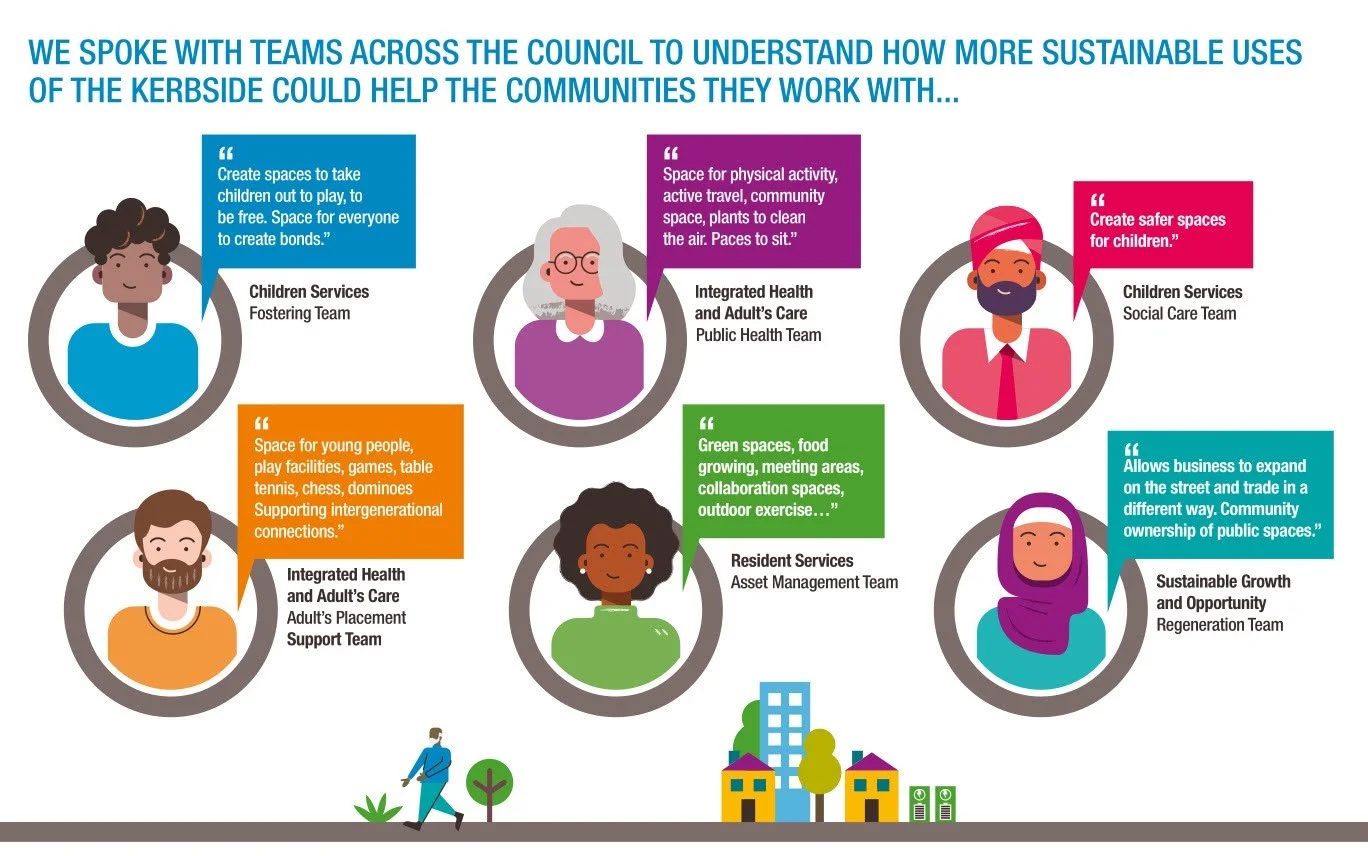
Lambeth officers asked teams across the council what more sustainable uses of the kerbside could do for the communities they work with. Source: Lambeth’s Kerbside Strategy, Appendix A (Lambeth Council, 2023), page 8.
© Lambeth Council.
Oxfordshire, the timing is right for a Kerbside Strategy. And we’re convening.
The kerbside is so much more than a strip of street. It’s about place. This public asset holds real potential to help with some of the most complex challenges of our time, from how we move, to making space for nature, play, rest, water and socialising, and even improving the economic vitality of our high streets.
The good news is the councils are not starting from scratch. The county council’s Local Transport and Connectivity Plan already puts walking and wheeling first and backs the Healthy Streets Approach. The emerging Street Design Guide asks for streets designed around people, and Vision Zero aims for no deaths or serious injuries on our roads. National planning policy asks new streets to put walking, wheeling and cycling first, with secure cycle parking, public seating and trees, and government has said it will publish an updated Manual for Streets.
And the ambition runs wider than transport. Oxford City Council’s strategy for 2024 to 2028 commits to thriving communities, zero carbon and tackling health inequality. Healthy place shaping is a core strategic priority for the county, and there is growing work on nature recovery and flood resilience.
A good kerbside strategy would go further still, asking what the kerbside can do for social connection, play, sustainability and the generations who will inherit our streets.
What’s missing is the bridge between all that ambition and the kerb outside your front door. A kerbside strategy is less about new policy than about giving the policies we already have coherence, and a way of thinking and acting on them together across council teams and priority areas.
A kerbside strategy would give officers and councillors a shared starting point, so the decisions already being made across teams fit together and less time goes on starting from scratch each time
And let’s face it, time saved on circular debate is not to be sniffed at.
Oxfordshire isn’t Lambeth. We need new homes. Much of the county depends on cars, and the alternatives haven’t caught up yet. So a strategy here has to be about choice and fairness, and it has to be adaptable for market towns and villages as well as Oxford. Officers know our kerbside better than anyone, and any Oxfordshire strategy would be built on that knowledge.
Oxfordshire Liveable Streets has been making the case for a Kerbside Strategy for some time. And we’re also curious about the benefits and pitfalls. To this end, we’ve invited Rezina Chowdhury to Oxford to share the Lambeth story and we’re inviting you to join.
Rezina led Lambeth’s Kerbside Strategy as Cabinet Member for Sustainable Lambeth and Clean Air, and was formerly Deputy Leader of the council. This won’t be just a presentation - you’ll hear first-hand from the people who shaped one of the UK’s most developed kerbside strategies, and you’ll have the chance to ask them what it took, what worked, what they would do differently.
We want to shape the session around what will help you most, so the sign-up form asks what you’d like us to cover. We’re inviting members, officers, councillors, community groups working on active travel, disability, nature and local business, micromobility operators and residents: anyone with a stake in the kerbside.
Two actions
1. Register your interest in the event.
We haven’t set a date or venue yet. Your input will help shape the right event so you get the most out of it. Please respond to the form here. This will likely be in January.
2. Respond to the live CPZ consultations.
Headington West: https://letstalk.oxfordshire.gov.uk/oxford_headingtonwest_parking2026
OLS support this except for the car parking space proposed at the northern end of Grays Rd, which is too close to the junction and would create a hazard. We are asking for at least some public cycle parking on every street (and a Kerbside Strategy ;))
Florence Park Road: https://letstalk.oxfordshire.gov.uk/oxford_florencepark_parking2026
OLS support this except for removing the Double Yellow Line on Florence Park Rd, as the rationale for this is not clear and it may make it harder to enforce against parking on the verge. We are asking for at least some public cycle parking here.