
Future Streets | Field Notes from Workshop 1
On the evening of 24th March, nearly 50 people from across Oxfordshire joined us online for the first Future Streets workshop. 56 people had registered. 48 were with us at peak. Oxford city was well represented, with people joining from East Oxford, Cowley, Blackbird Leys, North Oxford and Iffley. Beyond the city, participants came from Abingdon, Thame, Wallingford, Witney, Bicester, Wantage, Chipping Norton, and a handful of villages across the county. For a two-hour online evening session, we'll take that as a win!
A reminder of our starting point for this series, and workshop 1 : that streets and neighbourhoods could support more people to really thrive. But what does that actually mean in Oxfordshire? Peter Lefort facilitated a session that moved between personal reflection and systems thinking, unpacking what matters most, what needs to change, and what the idea of thriving in our places means for those who live here.
We’ve started the process of crunching the post it notes from all seven breakout rooms across five different core questions and we wanted to share some very early insights. But first;
Who was in the room, and who wasn't?
Future Streets is designed to be as inclusive as possible, aiming for broad representation across geography, ethnicity, ability, and travel mode . This is designed intentionally as an iterative process, learning from each workshop and shaping representation across the project arc as a whole.
Practically speaking, this means shaping the invitation to reach beyond the usual networks, removing barriers to participation, and building transparency into the process itself. That’s why, integrated into each workshop, are a set of questions that help us understand who's in the room. We use Mentimeter to make that visible to everyone present, and as a group we name the missing voices together. These vital insights shape outreach and invitations that follow.
Here's what we learned from Workshop 1.
Of those who responded to our demographic questions, 100% were white, 94% were homeowners, 78% had regular access to a car, and nobody aged 18-30 was present - "not at all representative" appeared in the chat as people saw the results come in. Walking was the most common way people get around, which reflects the active travel leaning of the room (and the fact that many work from home), but driving was the second highest mode, with 66% respondents travelling by car as a driver, followed by cycling and train, then bus. On gender, the room was reasonably balanced: 18 women, 11 men, and 1 non-binary participant. 16% identified as disabled or as having a long-term health condition that affects their daily life, not far off the national average.
We've taken four actions since Tuesday:
We’ve decided to run at least one in-person version of Workshop 1 targeted specifically at communities underrepresented on the 24th. One is booked and in the diary for Monday 13th April and the insights here will be integrated into data and insights.
Our outreach for Workshop 2 has specifically targeted and prioritised young people and we have confirmed under-18 participation from outside of Oxford
We're developing a digital , shareable version of the key questions in Workshop 1 for people who couldn't attend, so there's a lower-threshold route in to take part. This is currently in draft and will be ready to publish and circulate next week.
We've contacted or met with community connectors to reach people who won't come through our usual channels.
Now let’s take a look at what we heard from people. Participants were asked what they want to hold onto about their streets and neighbourhoods, what they'd let go of, what's missing, and what they'd keep away.
What people want to keep - and build on
There is real texture in the breadth and depth of responses across the group as a whole. Green space and nature featured in almost every group; keeping hold of what existed and bringing more in felt important. Alongside that, a deep appetite for social connection, local life, and feeling connected to it. "More accidental social contact between neighbours." "Kids playing on the street." "The quietness and talking to my neighbours on the streets."
Mobility featured strongly too, with how people move closely linked to how they feel. "Freedom to move without stress or anxiety”,; ‘really good bus routes between Oxfordshire towns’ , ‘affordable trains that work like they do in Europe’, ‘safe cycling infrastructure’, ‘wider pavements’. ‘independent local shops within walking distance’ . And underpinning all of it, more say over what happens to local places. All in, a sense that participants want places that are alive: with people, nature, children, neighbours, and independent local life.
What people want to leave behind
What was interesting here was the depth and breadth of what came through. Our scale is street and neighbourhood level, and the scope is effectively urban design, but participants brought a range of perspectives that pointed to a deeper story: streets that have stopped functioning as social spaces and become movement and storage corridors.
The dominant thread was car dominance: the volume, the noise, the fumes, and the space taken up by parked and moving vehicles. And alongside that: potholes, inaccessible pavements and pavement parking, litter and the volume of waste. The loss of green space to development and parking. Economic conditions that force out local independents. Sensory overload too: loud exhausts, visual clutter, streets that feel, in one participant's words, 'depressing, stuck.'
Planning failures that, as one group put it, create 'problems no amount of individual behaviour change can fix.' And something harder to pin down but real: a culture of 'blaming each other instead of focusing on solutions.’
Do bear in mind that is very early days for the project and there’s a lot be built on here. We've distilled comments from across seven breakout rooms into key themes and will be sharing more on the Workshop 1 page of our website next week. Over the course of the series, our share-backs will build in richness and nuance as we bring more and more people into the workshop rooms. Follow our social channels to be notified when updates go live.
Where is this going? The Power of Community-led Indicators.
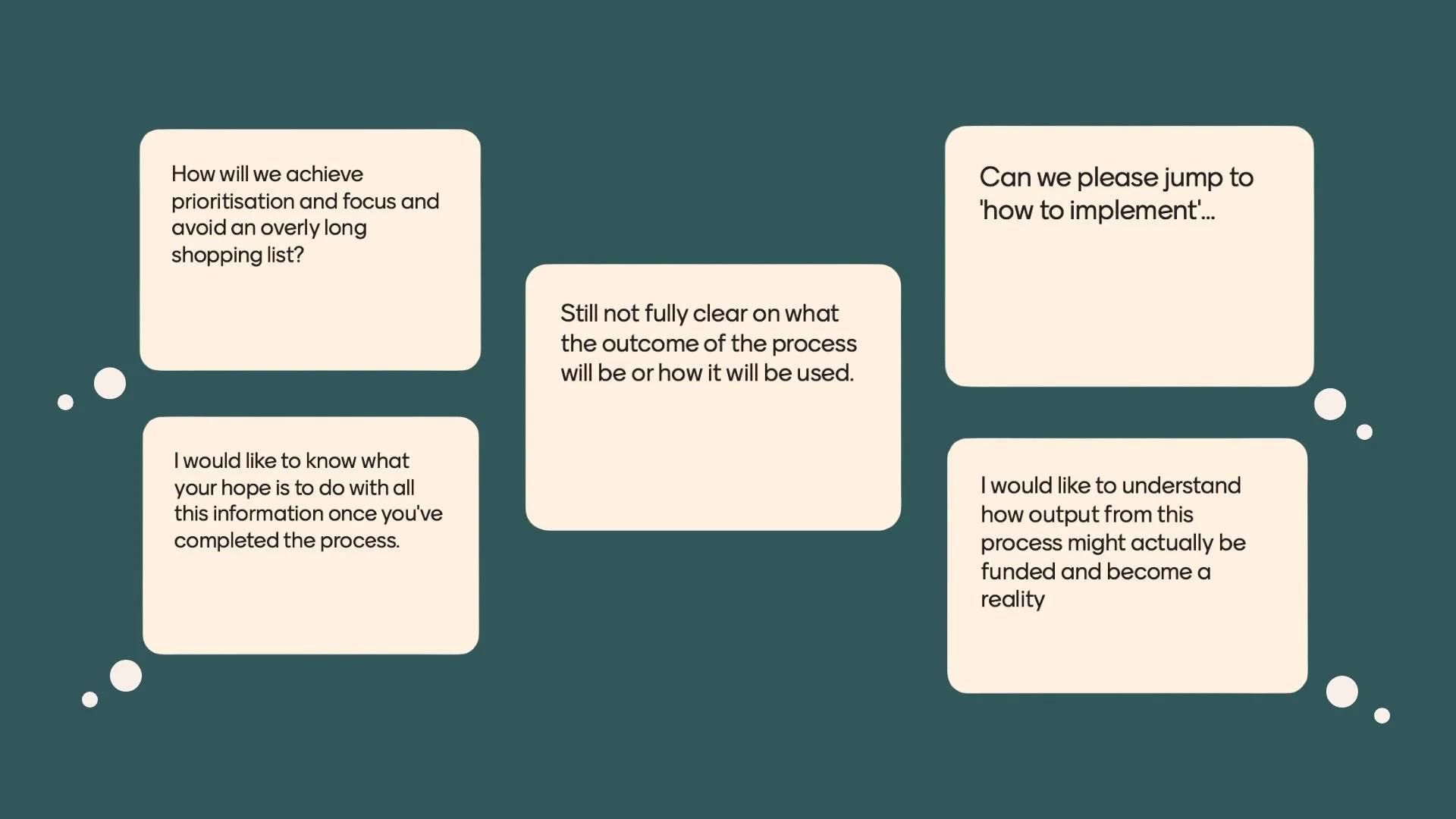
Sample comments from the Mentimeter
These were some of the questions asked right at the end the session when we invited comments. Given the breadth and depth of responses the questions of ‘how do we act on this?’ and ‘how do we make this a funded reality’ are natural. Unpacking so much can produce a sense of overwhelm at the sheer scale of ‘jobs to be done’.
First, do read more about the project here - that helps situate workshop 1 in the process and unpacks the outputs from the project.
Second, do read our February blog which explains how this project is designed as a learning cycle. TL;DR : we don't know yet what will emerge but the visions and indicators will become the spring board for understanding shared values and pathways to action that help expand what feels politically and practically possible.
Third, this is a really good moment to elaborate on the power of community-led indicators, or Cornerstone Indicators as they're known. The concept was developed by wellbeing economist Katherine Trebeck as a way to bring measures of progress out of technical policy documents and into everyday life.
The idea is that if you develop indicators with communities, rather than for them, they capture what genuinely matters to people.
Current institutional indicators for Oxfordshire include the healthy life expectancy gap, collision data, numbers of children seriously injured on roads, and years of healthy life lost to air pollution. These are important measures. But they are designed to track harm reduction, not human flourishing. They tell us whether things are getting less bad. They don't tell us what good actually looks and feels like to the people who live here.
Cornerstone Indicators are designed to sit alongside these institutional measures, not replace them. Where official indicators rightly focus on reducing harm, community-led indicators can tell the stories of what going right looks and feels like: the signals of change that matter to the people living through it. They can become a shared language for what progress means at street and neighbourhood level, a springboard for advocacy, and a reference point for decisions made by businesses, community organisations, and local government alike.
Cornerstone Indicators developed by local people hold real power and potential. They could unlock local business investment in change programmes, spawn grassroots movements at street and neighbourhood level, shift organisational priorities for civil society groups, and spark new collaborations and partnerships.
The aim is to move the conversation about what progress really means away from think tanks and policy spaces, and into the cafes, playgrounds and bus queues of everyday life, building shared accountability and agency across local economies as social systems for acting on what matters most to local people. Above all, what’s most important is that local voices are centered.
Read more at cornerstoneindicators.com.
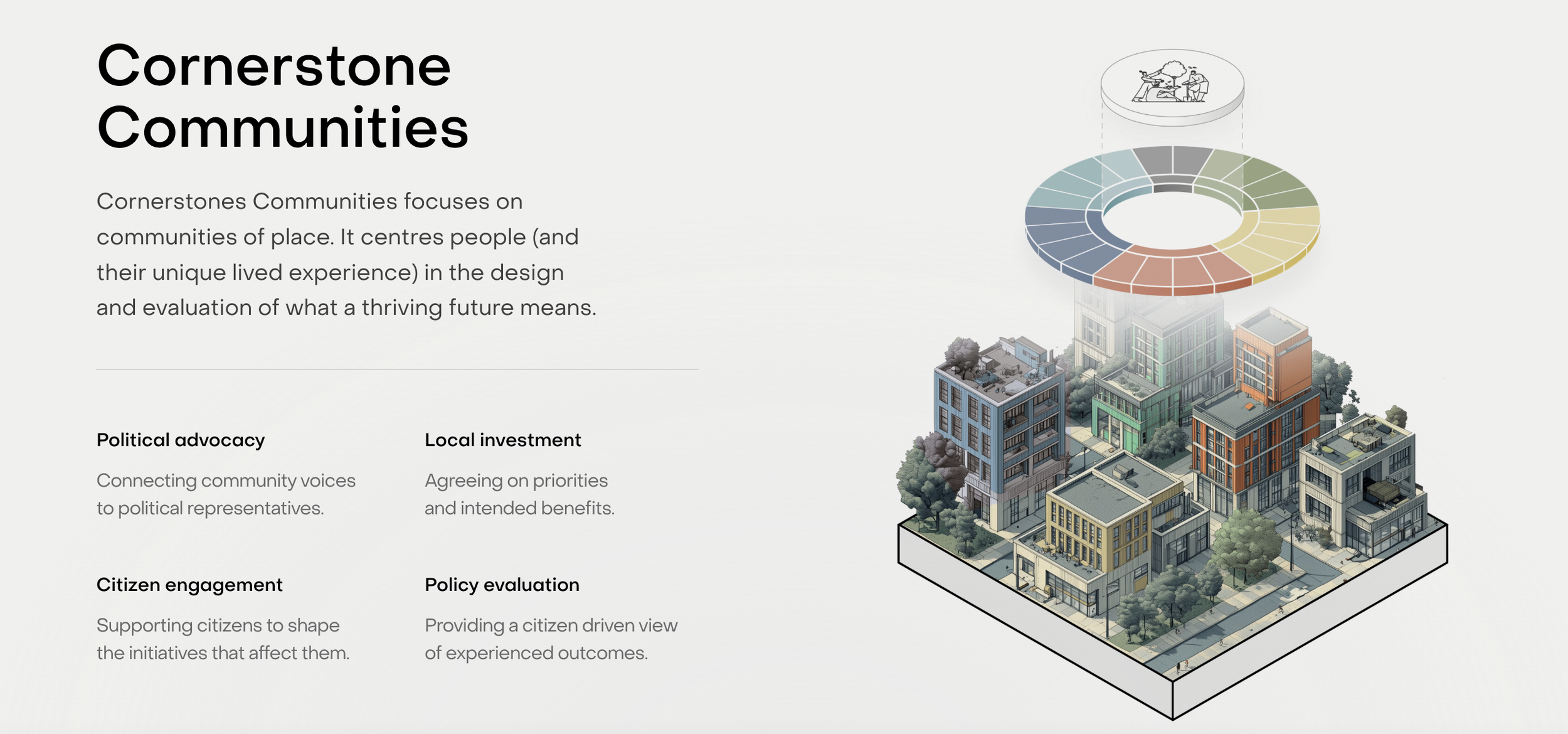
Cornerstone Communities
What's next?
So this is an invitation to sit with what's emerging. The project is designed as a build, with each workshop feeding the next.
Keep an eye out for fuller insights from Workshop 1, published on our website next week.
Couldn't make Workshop 1? A digital version is on its way, with a survey so you can contribute your own responses.
Workshop 2 is on 16th April at Oxford Town Hall, led by futurist Rob Hopkins, with live illustration by Richard Carman. It's a full day, and it's going to be something. Book your place here.
Follow our social channels to be notified of any new content updates. We’ll be publishing on LinkedIn , Instagram/ Facebook, and Bluesky.
We’d to close with special thanks to the facilitators who volunteered their time to run break out rooms with us. Facilitators came from the community of practice for Cornerstone Indicators stewarded by Peter Lefort and joined us from across the UK and the world .
Sophia, Kath, Nik, Miso, Zemina, Maria and Shrada - thank you.