
Future Streets Oxfordshire | The What and the Why
Someone asked us this week: "why should I come to the workshops? What are the objectives and outcomes of this work?"
Good questions. We dedicated this month's blog to answering them on the basis that others might have the same questions.
The website is up. Registrations are open. There's a lot to take in. To answer properly, we need to crack a nut first, one that will really help frame the logic behind this work
Outcomes-based planning vs systems learning
If you work in public services or civil society the ‘outcome-based vs systems learning’ tension will be familiar territory. But actually anyone who's ever had to write objectives or 'demonstrate impact' in any setting will probably recognise it too.
Outcomes-based thinking has its roots in New Public Management of the 1980s and 90s, the wave of audit culture and marketisation that swept through public services under the logic of "if you can't measure it, you can't manage it." It crystallises in the private and charity sector's propensity toward linear strategies, Theories of Change, logic models, and commissioning regimes that require organisations to specify inputs, outputs, outcomes and impact before a project even begins. Nightmare.
This is the absolute antithesis of what we're doing here.
We're coming at this from a systems-learning approach, which is highly sceptical of outcomes-based performance logic. In systems learning, the belief is that locking in outcomes before you've started can blind you to what's actually emerging, and to what communities actually need. The classic example: when a measure becomes a target, it ceases to be a good measure. Services and programmes optimise for what's counted, not what matters. And the outcomes that get counted are rarely the ones set by communities. They're set by funders, commissioners, and senior leaders and, ironically, don’t often lead to great outcomes. Read more here if interested.
So, holding the idea of systems-learning in mind, the objective for Future Streets is to create and hold spaces for the emergence of a genuine, community-owned picture of what thriving streets and neighbourhoods could look and feel like in Oxfordshire, whilst baking in accountability for what we learn. This, we believe, will ultimately lead to better outcomes for where change is needed most.
Developing our own indicators is, in essence, a radical act of civic empowerment, allowing citizens to decide on what impact in the community they want to see and measure - even if, at the time of developing them, they can’t actually be measured.
The legitimacy and accountability comes from two things:
who's in the room (which is why participation design is so central to this project), and
how we commit to taking what we learn forward.
Oxfordshire currently doesn't have a shared vision of what thriving streets and neighbourhoods look like. Not from a local government perspective (although there is great ambition in the policy), nor at community or civil society level either.
Here at OLS, we have lines of copy, aspirations, deep knowledge, lived experience, drive and an idea of what we're aiming for, embodied in the grey matter of founders, board members, and staff past and present. But it's not yet tangible. We, and the coalition we're part of, are driven by the desire for a healthier society, equitable access to streets and public space, and spatial justice at street-level. But we also know that a more diverse range of perspectives will build a more inclusive, more powerful picture of what thriving actually looks like.
Future Streets Oxfordshire is a step toward filling this gap, built from the bottom up, in a way that top-down planning simply cannot replicate. It will inform not just our work, but how we advocate.
Because even the best solutions need a story. Ambitious policy that runs ahead of shared vision tends to meet backlash, and we've all seen what that looks and feels like, especially with a media at the ready hungry for clicks and stoking polarisation with a hot poker.
OLS has a strong tradition of meeting people where they are in public engagement, and #FutureStreetsOxfordshire builds on that. It's about lifting our heads up and out of the day-to-day, and creating the conditions for a much wider group of people to understand, decide, and own what we're working toward.
“OLS has a strong tradition of meeting people where they are in public engagement, and #FutureStreetsOxfordshire builds on that,”
We're at a moment where climate breakdown, biodiversity loss, flood risk and democratic disaffection are all playing out in our streets and in our neighbourhoods at once. 'Decide and Provide' is locked in at County. A Kerbside Strategy is being tabled. More traffic reduction measures are in the pipeline. A unitary council is on the cards. The decisions that will shape Oxfordshire for a generation are being made right now. This is exactly the moment to take a conscious step back, look up, and build a shared picture of what we're actually working toward.
“This is exactly the moment to take a conscious step back, look up, and build a shared picture of what we’re actually working toward.”
Right. So there’s some context. Back to practicalities.
What will this work create?
By the end of the workshop series, we will have:
An illustrated vision of streets and neighbourhoods, validated online over the summer with a wider audience
A set of locally-meaningful indicators of change: the signals and stories of what progress looks and feels like in everyday life
Practical pathways: mapped enabling conditions with key stakeholders, decision makers and community voices for how we start bringing this future into the present. In other words, how do we activate the vision?
These will be distilled into a rich, illustrated, publicly accessible final report, shared with every participant. And we will hold a public launch event to share findings more widely.
What we don't know yet (and why that's the point)
The workshops are spaces specifically designed to unlock perspectives and ideas we simply can't anticipate. We're going into this with a level of unknowing. Here's where the potential lies:
A co-created vision acts as a north star: a shared reference point that expands what feels politically and practically possible, and gives communities and decision-makers something to orient around together.
Community-led indicators give us a shared language for change in human terms, not just data. But they can also unlock new relationships, collaborations, and actions. Creating them is, in essence, an act of civic empowerment: communities deciding what impact they want to see and how to measure it. Until we get people together, we won't know what will come out. And that's genuinely exciting.
Workshop 5, Enabling Conditions, is where all the threads come together. This in-person session is specifically designed to bring residents and community voices into the room alongside people with the power to act: local officials, planners, funders, businesses, community leaders. What gets unlocked there, we hope, becomes the foundation for practical action that outlasts the project itself. This will set the trajectory for the next 3 to 5 years.
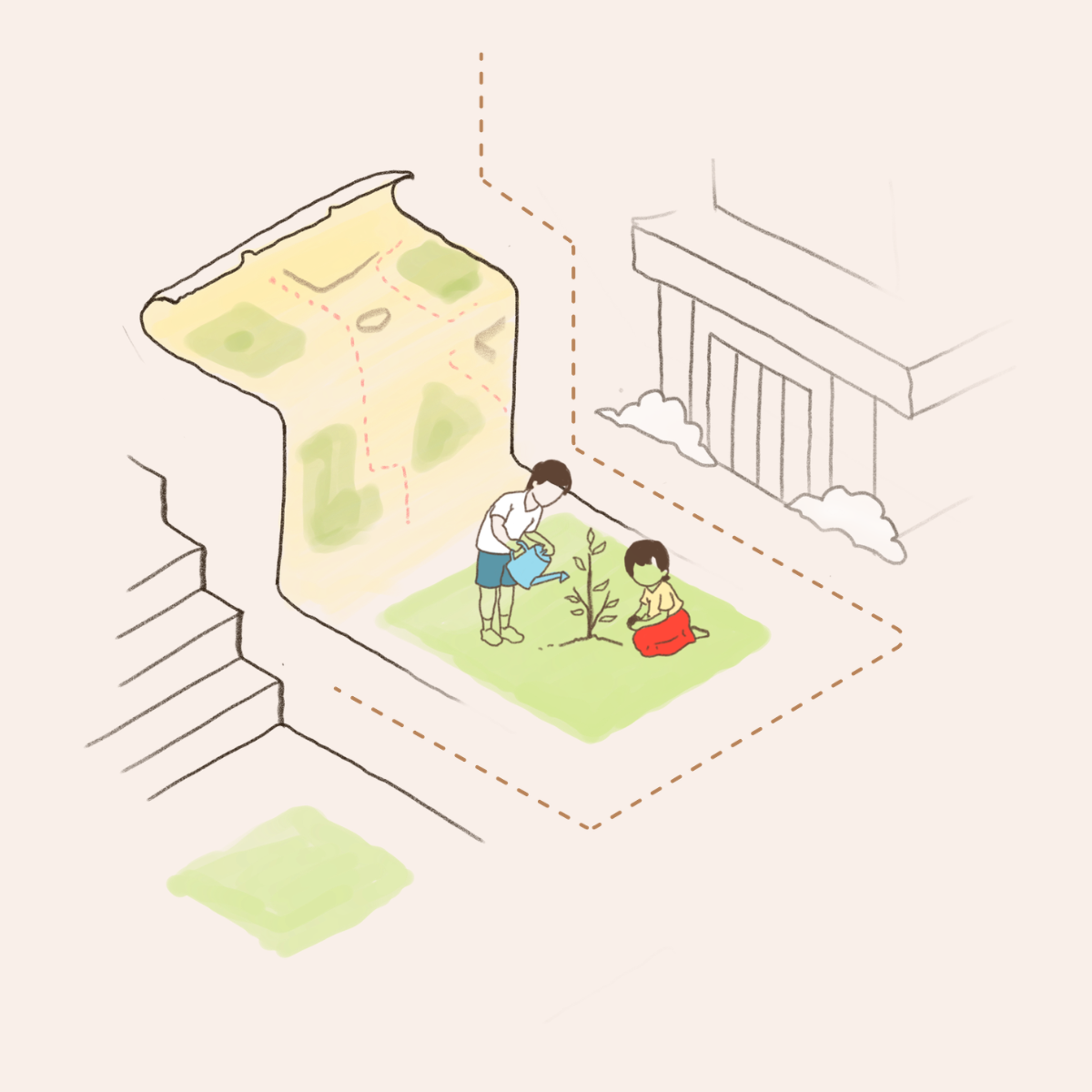
Nurturing enabling conditions. An illustration by Suyash Sinha from the Future Streets team.
And then there's the ‘outcome’ we can plan for, but not predict. When people who wouldn't normally be in the same conversation meet, unexpected things emerge. Ideas none of us would arrive at alone. A sense of shared agency that creates its own ripple effects. The beginning of hyperlocal resilience building. That's not easy to log or measure. But it matters enormously anyway.
So, who's this for and why come?
We've tried to answer this on this page of the website, from residents and disabled people to business owners, councillors, young people, and civil society organisers. Head there and see if you find yourself. And if you don't, or if what you're hoping for isn't reflected, tell us. Email Siobhann directly at siobhann@oxfordshireliveablestreets.org.
If you don't feel represented in the existing processes, come.
If you're bone tired from pushing hard for change but feel like you're standing still, come.
If you feel that Oxfordshire has so much potential but we're locked in silos and lanes that make progress hard, come.
If you're frustrated by the gap between ambition and progress, definitely come.
If you're sceptical about 'visioning' and what might actually come of it, especially come.
And finally, a note of thanks
None of this would be possible without two things: a funder with the courage to back a project that deliberately resists outcomes-based logic, and a board willing to take a leap.
This work is a departure from what OLS is used to. So particular thanks to our board, chaired by Simon Pratt, and to Damian, Hannah, Laura, Danny and Jan, for their trust, their support, and for acting as enablers for something genuinely new.
Systems-learning approaches are notoriously difficult to fund and to govern. We're grateful to everyone who's chosen to back this anyway, and to see where it leads.