
Beyond the Charge | An Equity Test for Traffic Scheme Revenue
Oxford’s Temporary Congestion Charge investment plan was approved at Cabinet in May. Roads are clearer, buses are more reliable, and the surplus is being reinvested in ways that go beyond just managing traffic. We welcome the direction, particularly the hospital express bus service and the travel offers for NHS and school staff.
In March, Oxfordshire Liveable Streets (OLS), Headington Liveable Streets (HLS), and The Coalition for Healthy Streets and Active Travel (CoHSAT) submitted a briefing paper to Oxfordshire County Council on equity-led spending priorities for revenue from Oxford's traffic reduction schemes. It's encouraging to see a number of those priorities reflected in the approved plan. This blog unpacks the OLS-HLS Equity Lens and makes the case for why it should shape every traffic scheme that follows.
Liveability: affordability and access
Liveability, in its broadest sense, is about the conditions that enable people to thrive physically, socially and economically. It is about daily needs being within reach, environments that support wellbeing, and the costs of living and moving around being manageable. How people get around, including the affordability, reliability and accessibility of their options, sits at the heart of this. Affordable transport determines whether people can access work, education, healthcare and social connection, or whether they become locked into car dependence that, over time, reduces rather than expands their access to local life.
Transport poverty is increasingly recognised as a measurable policy issue. Revenue use can either reinforce existing inequities, or reduce them.
The harms of car-dominated streets aren’t evenly shared
There is a well-established body of research on what car-dominated streets actually do to the people who live alongside them. Donald Appleyard’s original Liveable Streets research in 1981 documented how traffic measurably degraded the quality of life of residents, workers and visitors who shared the street environment. Since then, his son Bruce has taken that work further, bringing an ethical lens to the same question: “one person’s pursuit of quality of life can harm the liveability of another. This is especially true in transportation.” As wealth and social status often play a key role in determining whose pursuit of quality of life wins, he argues, a moral and ethical framework must be at the heart of how we plan and invest in transport.
“One person’s pursuit of quality of life can harm the liveability of another. This is especially true in transportation.”
That framing applies directly to how revenue from the temporary congestion charge - and all future traffic reduction schemes - gets spent. The charge itself begins to rebalance some of the costs. But revenue use can either reinforce existing inequities, or reduce them. How it is spent is not a neutral question.
Thinking about fairness: four lenses
In our March briefing on Equity-Led Spending Priorities, we set out an equity lens approach for guiding how revenue from traffic reduction schemes gets allocated. There are four dimensions;
The first is equity across groups: are the benefits reaching lower-income and non-car households, and does the scheme design avoid disproportionately disadvantaging any particular cohort?
The second is spatial justice: are benefits spread fairly across places, not just concentrated within the charging boundary? Congestion impacts, air pollution exposure and gaps in safe infrastructure don’t stop at the edge of a charging zone. Areas that bear a heavy destination traffic burden, like Headington with its hospitals, universities and schools drawing tens of thousands of workers and patients every weekday, can carry significant costs without being within the area the charge was designed to address.
The third is equity of mode: does the revenue reinvestment avoid creating perverse incentives that advantage driving over cleaner alternatives? This is more subtle than it sounds. If the best-value bus fares are only available to people who drive to a Park and Ride, the pricing structure is effectively rewarding driving as a precondition for accessing public transport.
The fourth is equity of access to the network: are we reaching people who are excluded from standard transport options entirely? Older people, disabled people, people without access to a car due to poverty or age. Standard equity tests built around bus affordability and active travel access can systematically miss these residents. They often pay more and travel less reliably to reach essential services.
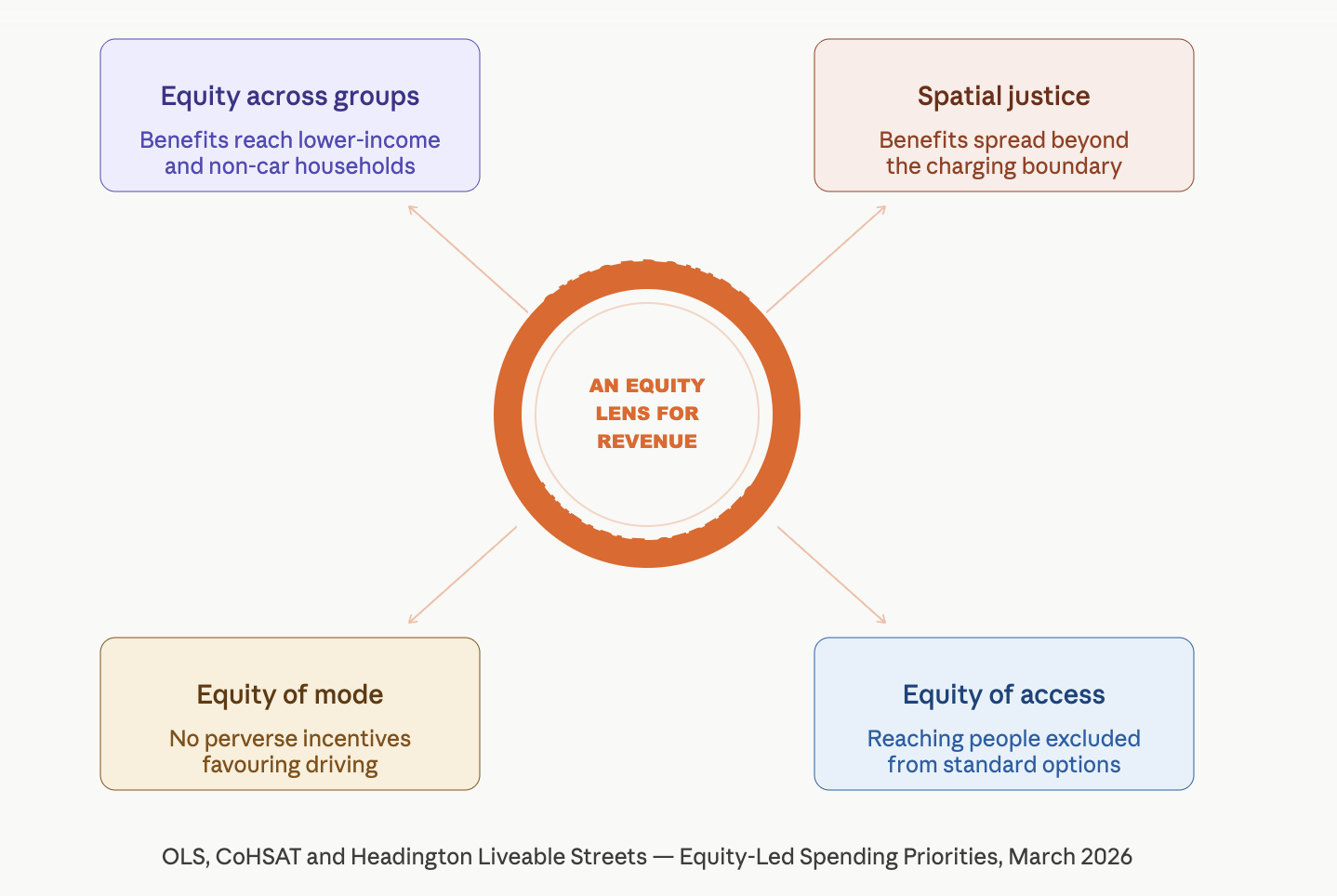
The OLS-HLS Equity Lens
What we know from elsewhere
Oxford is not the first place to grapple with these questions. International evidence on congestion charging consistently points to the same lesson: who benefits from reinvestment shapes both public confidence and equity outcomes. People need to see a credible alternative to driving, and the money raised needs to be visibly reinvested in something that benefits them - particularly those with the least choice.
Stockholm implemented congestion charging as a time-limited trial, with 16 new bus lines launching four months before the charge came in, so that residents so that residents had a real alternative before they were charged. Oxford didn't have that luxury - congestion was actively degrading bus services and suppressing demand. The charge came first, and the revenue is now enabling the investment in alternatives.
Multiple reviews of the Stockholm experience highlight the importance of explaining objectives and expected benefits clearly, in advance, so that people understand what the scheme is for and what they are getting back. (Eliasson et al., 2009). Detailed modelling of the scheme found that if revenues are reinvested in public transport, women and lower-income groups benefit most - making the scheme progressive rather than regressive. The key variable is not the charge itself, but what happens to the money. (Eliasson and Mattsson, 2006)
Gothenburg took a similar approach, embedding its charging scheme within a wider transport and infrastructure package, with revenues used to co-finance longer-term investment alongside nearer-term improvements. (Pickford et al. / WRI, 2017)
Evidence syntheses consistently find that reinvesting road-pricing revenue in public and active transport can benefit lower-income and non-car households and increase public acceptability by improving practical alternatives to driving. (ITF/OECD, 2018)
Strong steps in the right direction
What makes the Oxford approach particularly worth celebrating is the partnership with bus operators and the re-investment feedback loop into better services. This aligns strongly with best practice from other places. Further, it builds a clear, legible, and communicable story of public gain. Since the charge came in, Go-Ahead has recorded around 11,000 additional return journeys per week on park and ride services alone. That is a meaningful shift in behaviour at the city boundary, where Oxford's congestion problem has historically been hardest to address.
The new investment plan builds on that success. The hospital express bus service responds directly to the Citizens' Assembly's top recommendation and begins to address one of the most stubborn destination access problems in the city - a priority we had also made the case for in our March briefing. Free bus travel for NHS and school staff recognises that the people who keep Oxford's hospitals and schools running deserve a genuinely competitive alternative to driving in. Free bus travel for Connect to Work participants takes the equity logic further - recognising that the cost of getting to work or training is a real barrier for people with the least flexibility. The active travel allocation, though modest, is a start - there's work to be done to get this right.
At Cabinet, OLS Infrastructure Director Danny Yee made the case for infrastructure investment that yields the highest equity returns. The Cowley and East Oxford LTNs, he noted, have been the most effective public health interventions in Oxford in the last fifty years. Reducing traffic makes way for active travel, and these interventions widen who can get around independently, particularly for people who cannot afford to drive. But we are also mindful that benefits need to reach the fringes of the charging geography, not just its centre, and the people bearing the heaviest traffic burden are not always the ones who benefit most from where the money lands.
Active travel schemes vary enormously in their impact per pound. The right choices could deliver many times more than the wrong ones.
For the many people in Oxfordshire who don't have a car or can't afford to drive, these are meaningful steps and the impact of smaller interventions shouldn't be underestimated. Over time, we will see the allocation of revenue from traffic schemes to active travel and public transport grow. Done well, this is some of the most powerful investments a city can make: in streets that work for everyone, and neighbourhoods where getting around doesn't depend on owning a car.
Beyond the charge
The Congestion Charge is one (temporary) scheme. Traffic Filters, the Zero Emission Zone, and the Workplace Parking Levy are all coming and each will raise questions about revenue, reinvestment, and who benefits. Taking an equity lens to strategic decision-making and investment can ensure that revenue from these schemes embeds fairness and addresses inequality over time. The principles that make Oxford's current approach worth celebrating are the same ones that should guide what comes next: reinvestment that strengthens practical alternatives to driving, and builds legitimacy through visible public benefit across all modes.
The choices made now about how to spend, report, and iterate will set the terms for public confidence in whatever follows. Done well, this is how a city shifts from managing traffic to creating the conditions for streets and neighbourhoods where people can genuinely thrive.