
Three Councils, and the streets in between.
This is Siobhann writing as Oxfordshire Liveable Streets' new and first Managing Director, at a time of considerable flux and uncertainty. In July the government confirmed that Oxfordshire's county and district councils will be replaced by three new unitary councils, Greater Oxford, Northern Oxfordshire and Ridgeway, going live in April 2028. It is the biggest change to how decisions get made about Oxfordshire's streets in a generation.
The intent of this piece is deliberately reflective while looking forward. We are at a moment where the wheels are in motion as the land beneath our tyres is shape-shifting. Nobody has answers yet, but certainly a lot of questions.
These reflections come towards the end of the Future Streets Oxfordshire participatory design project and ahead of any published outputs, but what we have learned so far is already beginning to shape the road ahead.
If anything, the LGR outcome has sharpened how needed this work is. Designed and planned back in January this year so that our final workshop landed in the autumn, we of course had no idea back then what the shape of Oxfordshire would be, come this moment.
And now here we are.
What has been decided
In July the government confirmed three new unitary councils. Greater Oxford, taking in the city and a ring of parishes around it. Northern Oxfordshire, covering Banbury, Bicester and Witney. Ridgeway, covering southern Oxfordshire and, unusually, West Berkshire. The county council and the districts go.
Each of the three will be responsible for the full range of council services in its area. Social care, education, housing, planning, waste, libraries, parks. And highways and transport.
Elections for the new unitary councils are in May 2027. Those elected will first serve as shadow authorities, preparing the new councils before they formally go live in April 2028. There is more detail at oxfordshire.gov.uk, and the full three-council proposal at 3councils.org
One further thing is unresolved. The government has said there is currently no local consensus on devolution in this area, so a strategic authority for the wider region has not been agreed and has no date. We could still end up with a mayoral authority holding strategic direction across all three.
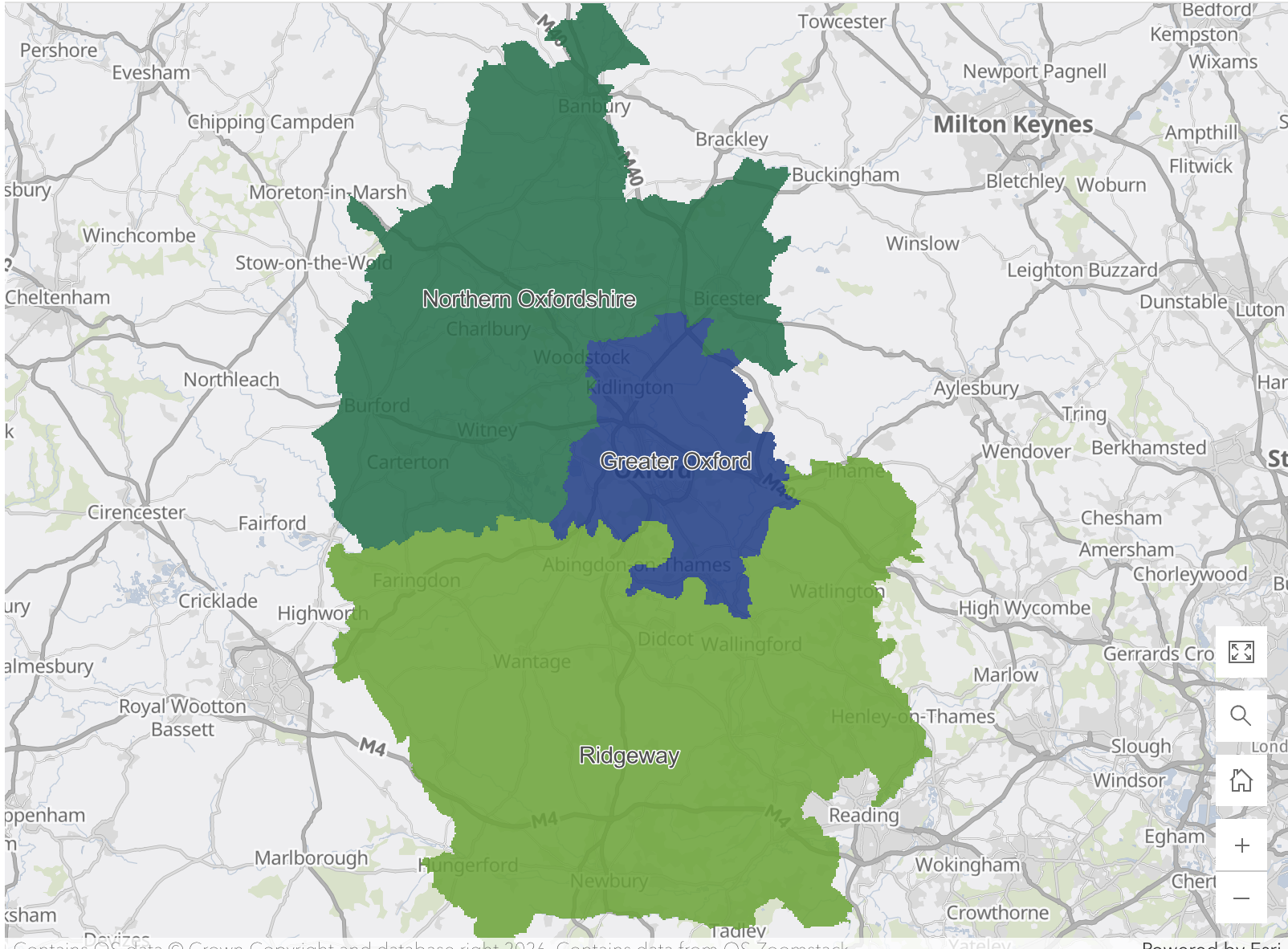
Map: 3councils.org. Contains OS data, Crown Copyright 2026.
Some obvious questions we’re sitting with, organisationally
For an organisation with a county-wide advocacy platform, historically rooted in equitable transport and infrastructure, this poses some obvious challenges.
How might we advocate for joined-up, equitable transport across three separate authorities?
How do we hold onto the whole picture when journeys cross boundaries and decisions no longer do?
How do interests get balanced when the people who travel into Oxford and the people who live in it no longer share a council?
What happens to the county-wide things? Vision Zero. The transport plan. The kerbside strategy Oxfordshire still does not have. One home becomes three?
And who gets left behind? Three authorities could mean three standards of transport, with investment flowing to the places that already shout loudest, and the towns with the least capacity falling further behind.
But I am not here to rail.
We are a small organisation and we will have to think hard about how we work across three places.The decision is made, and honestly, what I am seeing is opportunity.
Because here is the thing we have been living with; right now, planning and housing sit with the city and the districts. Highways and transport sit with the county. A development can be consented by one authority while another is only a consultee on the streets that will serve it. We have spent a lot of time in that gap. It is where great policy goes to die.
From 2028, each authority owns housing, planning, transport, public health and parks in the same place, accountable to the same residents. There is a strong case, in transport terms, for a single county-wide unitary, one authority holding the whole network, one plan. That is not what we have, and three authorities will bring their own challenges. But even so, three councils each holding everything is a substantial improvement on the six holding pieces we have now.
Moving forward
Let's come back to the idea of liveability and what it means for people to really flourish in their places. As a doughnut economics practitioner, I find it impossible to separate that mindset from my thinking, a way of looking at the world I know is shared by many across this county. It asks a simple question of any place. Is everyone able to meet their needs and live well, within the means of the planet that supports us? For a county of our wealth, that means reckoning with a footprint that reaches well beyond our own boundaries.
The proposal that came with the LGR decision runs to 244 pages. It talks about prevention more than seventy times. Neighbourhoods, more than forty. Children, over a hundred. It cites a fourteen year gap in life expectancy for men across the area, and a quarter of children in Oxford living below the poverty line. It commits to place-based services built around neighbourhood health, with neighbourhood geographies drawn to match primary care networks.
But designing and delivering place-based transformation and development is not the job of local government alone. Our economy is a social system in itself, made up of businesses and investors, anchor institutions, civil society organisations, community wealth and commons builders, and residents themselves.
I won’t be the only thing thinking that deeper collaboration and partnership working will be vital. And this is where what we are hearing through Future Streets Oxfordshire comes into sharp relief.
Over four workshops, we have been working with people from across the county to describe what getting it right actually looks and feels like in the places they live. Participation has spanned what will become all three unitaries, and across geography, dis/ability and ethnicity. And the common ground on what people want from their places has been staggering, even for us at OLS, with our noses to the glass.
Welcoming places to gather, for every generation, ethnicity and creed, nature flourishing around them, local businesses and services thriving. Street art. Play. Festivals. And more say; to be heard and play a part in how decisions are made and how places are shaped.
“People dreamed of places where buses were free and neighbourhoods were places for slowing down and connecting — tree canopies for shade, benches to stop and talk, pocket parks, farmers’ markets and repair cafes, streets alive with art and music, places to rest and linger, lovely wide pavements and safe walking routes. Of gentle transport and cargo bikes carrying children to school. Of thriving local businesses where everyone can get what they need close to home and bump into someone they know on the way. Of parking spaces turned into growing beds, and solar panels powering the street beneath them”
Underneath the specifics, some clear patterns. Good community life depends on shared physical places and rituals that are accessible to all, not just those who can afford a car, a garden, or a quiet street to live on. It depends on being able to reach what you need, the shop, the school, the surgery, a friend. It depends on being able to move safely and easily, at street level and between neighbourhoods and towns. And it depends on green space and nature being regarded as vital life infrastructure, allowed to exist and to be woven into streets and spaces. There’s more besides.
And what we know is this. How people move cannot be divorced from place. We do not live our streets in pieces. And yet our systems still plan them that way. When people describe what they want from their places, they never describe the parts. They describe a life. What it feels like to live there.
Future Streets Oxfordshire was designed as a learning cycle, a way to get under the skin of what people want from their places. What it has taught us is that for OLS to be effective, we need to think and do outside the lane we are most comfortable in. The three unitary decision has only affirmed that.
So we need to be more intentional about working across systems, food, housing, health, nature and movement, as well as across the three unitaries. The public realm is where they meet. Collaboration, dialogue, and getting people together in rooms at every scale will be key.
I hold optimism for what lies ahead, but no illusion that it will be straightforward. The path forward will be complex and certainly non-linear. This is the reality of working in complex systems. To take a systems mindset is to hold the chaos gently in one's hand, accept that this is where we are, and find ways to navigate it in the best ways we can at any given moment, in relationship.
Final thoughts
We are a county of relative wealth with extremes of inequality inside it, and a health inequality gap that is widening. We are seriously water stressed [1]. We sit in one of the most nature-depleted countries in the world, and Oxfordshire reflects the national picture. Just 14% of the county is semi-natural habitat [2], against a national commitment to protect 30% of land for nature by 2030. And we are about to build tens of thousands of homes, across three new councils, with no strategic body yet agreed above them.
Perhaps our greatest challenge is managing development and sustainability in a way that addresses all of this at once. Tens of thousands of homes equates to hundreds of thousands of new journeys and over decades. And we are attempting it at a time when the dominant growth-led paradigm, and the ways we design policy and projects, still have no real way of accounting for trade-offs.
I do not think the answer to that arrives as a strategy document. It arrives when enough people, in enough rooms, at enough scales, have said out loud what they want their places to be, and someone has written it down carefully enough that it holds when the hard choices come.
Future Streets is one contribution to that, not the whole of it. Our fifth and final workshop lands this autumn, bringing elected members, officers, residents, community leaders into the same room to ask what thriving neighbourhoods that work for everyone could look like in an Oxfordshire that is about to be redrawn.
But no single project, and certainly no single organisation, is going to hold this.
What I think we need, and what I would like to invite others into, is a way of working that is genuinely place-based and genuinely relational. Rooted in particular streets, neighbourhoods and towns, but held in relationship across organisations, so that what we each bring to the challenge adds up to something bigger than the sum of its parts.
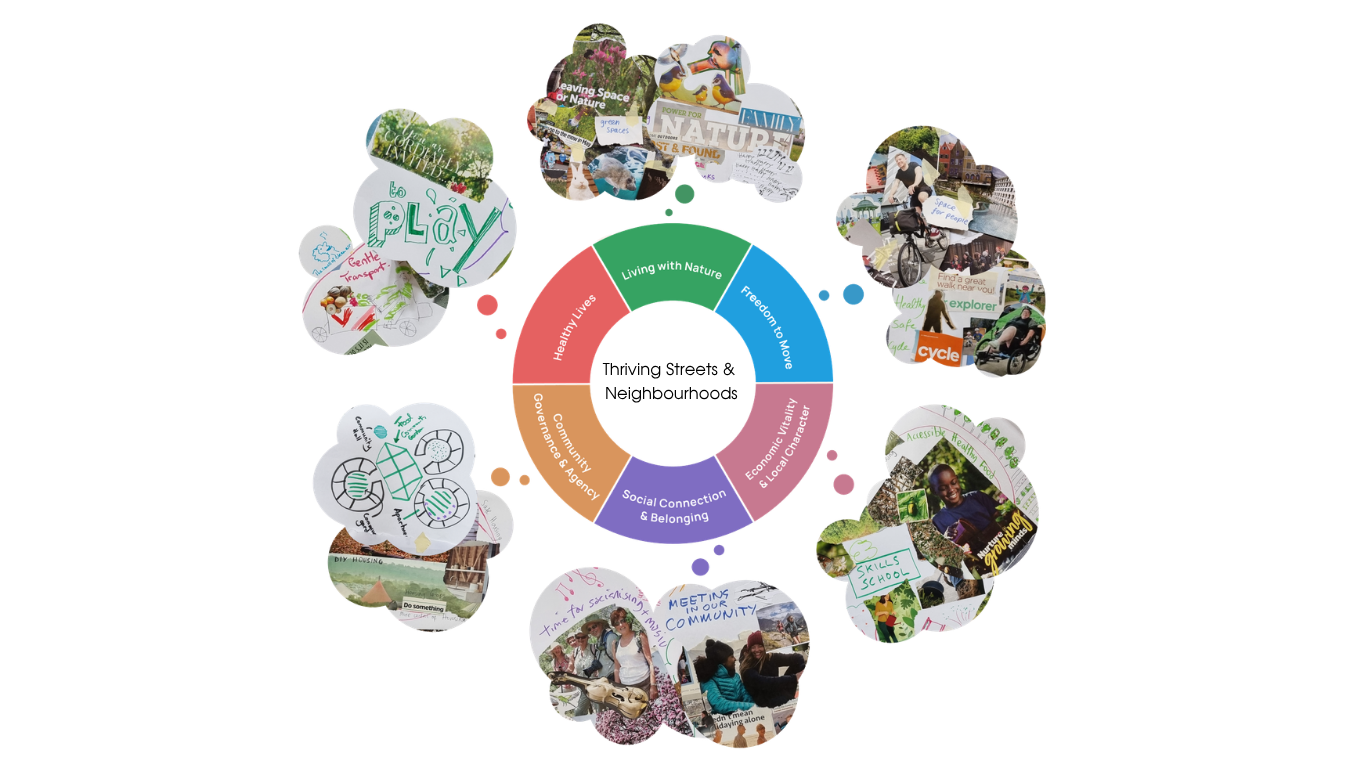
The theme wheel from Future Streets Oxfordshire. Themes shaped by participation across workshops
If your organisation is thinking about what reorganisation means for the places you care about, and you see yourself and your organisation somewhere in this wheel, I’d love to hear from you. Not to agree positions, but to consider how we might work more closely together on shared aims. Contact me directly at siobhann@oxfordshireliveablestreets.org
The councils that will shape Oxfordshire's streets for the next generation do not exist yet. Their priorities are being written now, by people who have not yet been asked what a good neighbourhood should feel like.
That seems to me like an opportunity, not a problem.
[1] Environment Agency classification of the Thames River Basin District, which includes Oxfordshire, as an area of serious water stress. Cited in An Oxfordshire Preliminary Data Portrait of Place, Oxfordshire Doughnut Project, 2024, p.54. Available at doughnuteconomics.org
[2] Alison Smith, Leverhulme Centre for Nature Recovery, Agile Nature Recovery Map for Oxfordshire, cited in An Oxfordshire Preliminary Data Portrait of Place, Oxfordshire Doughnut Project, 2024, p.75. Available at doughnuteconomics.org