
Insights from Liveable Neighbourhoods 2025 – and what it means for Oxfordshire
If you only know “liveable neighbourhoods” from Oxfordshire social media, you’d be forgiven for thinking it’s just another way of saying “war on motorists”.
For the last few years, Oxfordshire Liveable Streets has been right in the thick of highly polarised schemes: Low Traffic Neighbourhoods, Traffic Filters, and now the Congestion Charge. Locally, the very idea of a “liveable neighbourhood” has become tangled up with enforced traffic reduction and fears about lost freedom.
So we went to the Liveable Neighbourhoods Conference with a simple question:
What are other places actually doing when they say “liveable neighbourhoods” – and what can we learn about making change stick in a fairer, more human way?
We came away with a clear message: in the places leading this agenda, liveable neighbourhoods are about far more than traffic reduction. They’re about community connections, safe and pleasant places to be in and gather, health and wellbeing, climate resilience, and making everyday streets places where people can thrive.
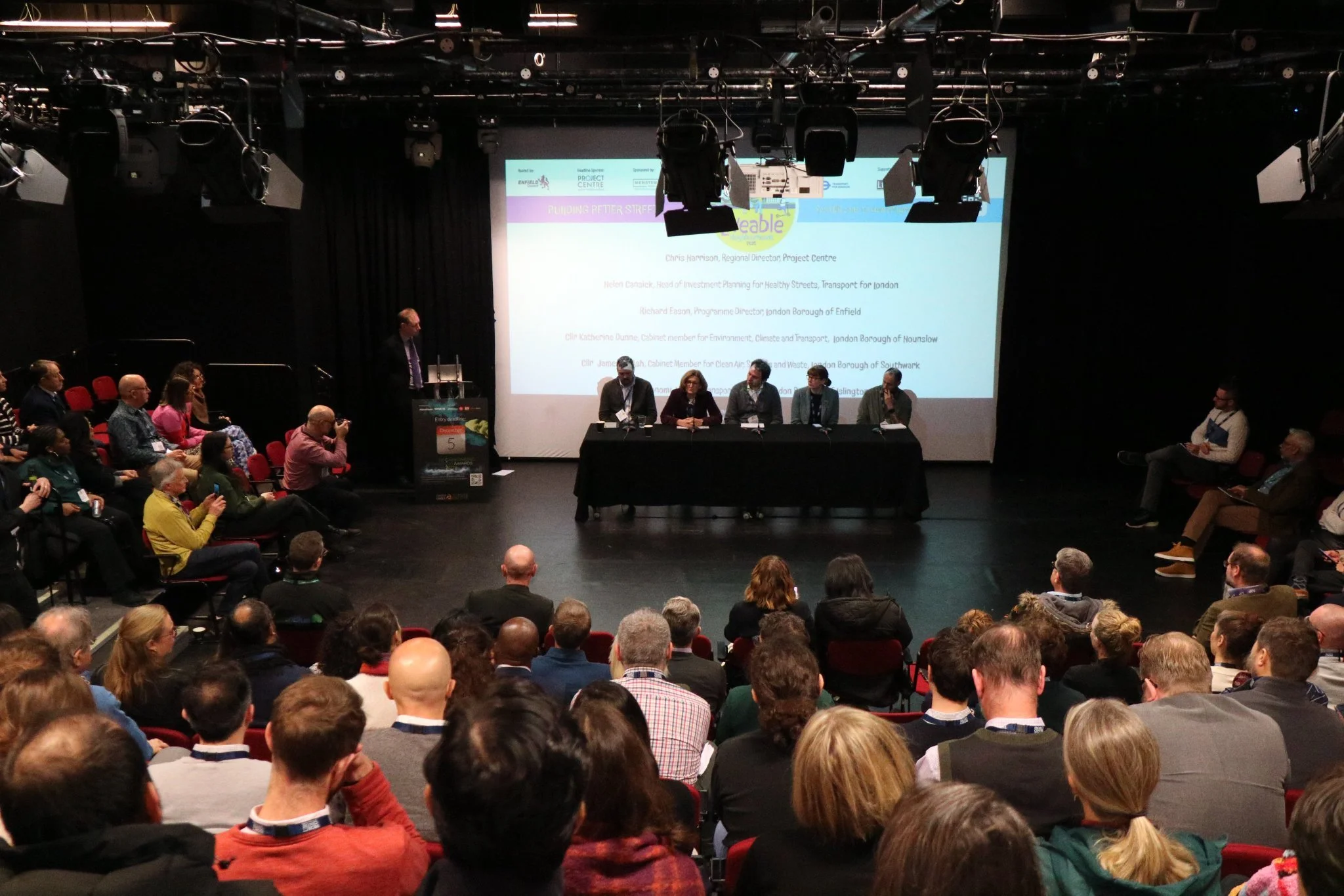
Photo credit: Journey & Places Enfield
Part 1: What we heard from places leading the way
1. Beyond LTNs and traffic filters: what ‘liveable’ really looks like
One of the first things we heard, from Enfield, was that they don’t really talk about “LTNs” any more. They talk about “quieter neighbourhoods.” It sounds small, but it signals something bigger: this is about the feel of the place, not just the flow of traffic.
In borough after borough, the focus is on re-imagining streets as social, green, and safe spaces that really centre human health and well-being:
In Enfield, the Journeys & Places team and active travel officers work hand-in-hand with public health to deliver climate, health, community and economic benefits – not just transport schemes.
Cllr Katherine Dunne described Hounslow’s Chiswick scheme as “an LTN plus”: yes, less through-traffic, but also integrated planting and greening. Not just removing cars, but adding somewhere nicer to be.
Islington’s Mildmay liveable neighbourhood combines school streets, traffic reduction, play features and greening across a whole area – part of a shift from standalone LTNs to a neighbourhood-wide approach.
In Lambeth, a kerbside strategy now links LTNs to a wider plan for trees, rain gardens, benches, cycle parking and accessible public realm. By 2030, they want a quarter of kerbside space to be “sustainable”.
We also noticed something telling in the metrics: Transport for London highlighted impressive ‘benefits’ from Liveable Neighbourhood schemes - reductions in deaths, serious injuries and collisions – vital, of course, but still framed as “less harm” rather than “more wellbeing”. There was a clear sense from us that the positive social side of the ledger – belonging, play, connection – is still under-expressed in the data, even when it’s obvious in the streets themselves. Liveability needs to be about far more than just surviving without injury!
Again and again, we heard versions of the same idea: traffic reduction is necessary, but it’s not the whole story. People also want trees, benches, safe crossings, places to rest, and somewhere their kids can play, safe journeys to school. And of course the relationship is not lost on us - in order to deliver the benefits, places first need to reduce harmful traffic levels.
For Oxfordshire, where people often only see filters and planters, this matters. It suggests that if we want to talk credibly about “liveable neighbourhoods”, we have to show and deliver the visible, lived benefits – not just the restrictions.
2. Engagement is the work, not the add-on
If there was one word that echoed through the day, it was this: engage.
“Engage, engage, engage” said Richard Eason (Programme Director) from Enfield. Their teams are accredited in public participation and have a clear engagement strategy for each project stage – from early listening through to detailed design and beyond.
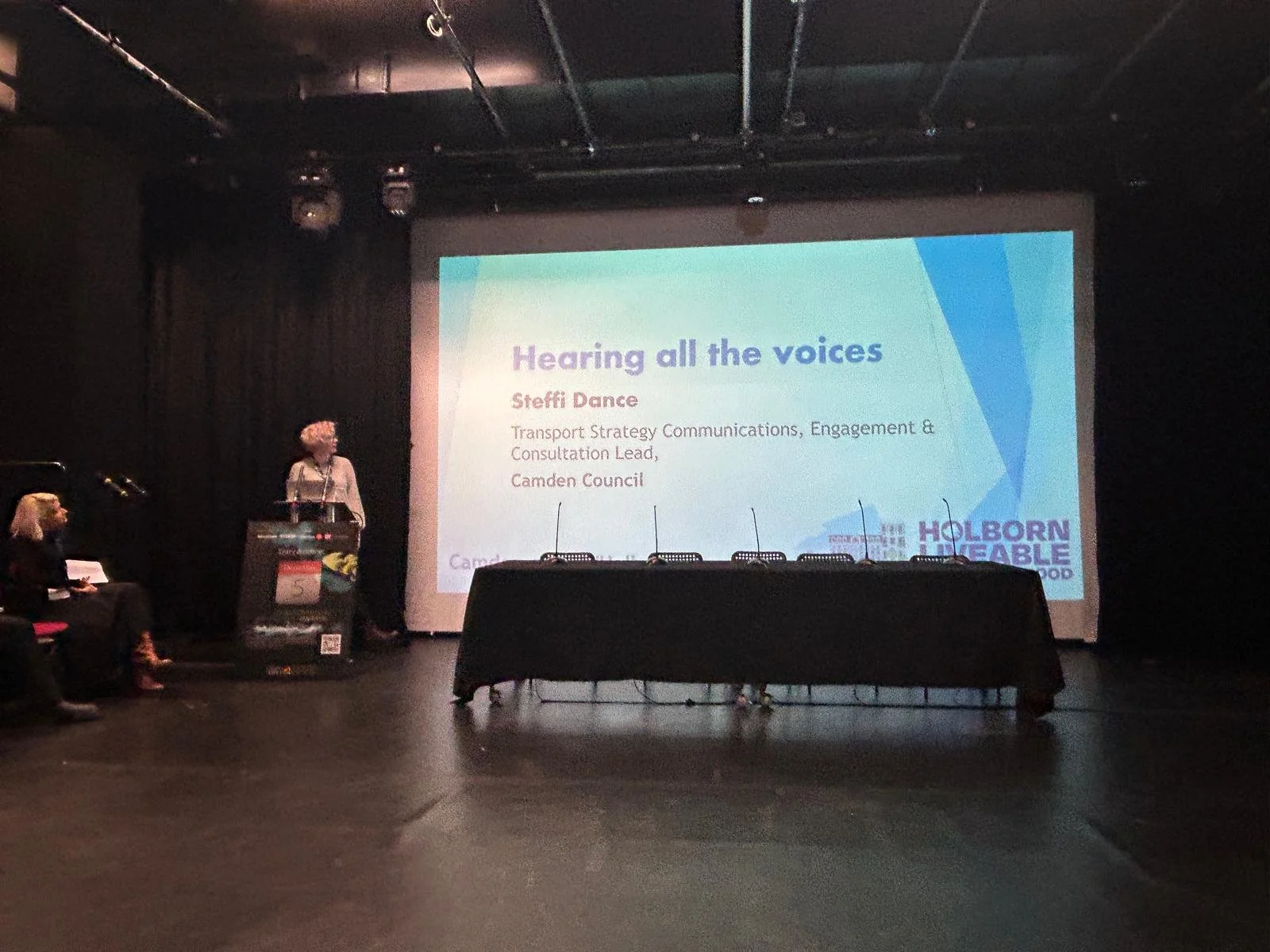
Steffi Dance, Camden Council
Things we heard, loved and logged;
Enfield using “meanwhile” experiments – pop-up seating, planting, events and a temporary pavilion – to co-design a new town square with the community, building confidence in the longer-term vision,. Bit by bit.
Camden getting serious about who is (and isn’t) in the room: benchmarking consultation responses against local demographics, then actively seeking out under-represented groups – from women’s night-time safety groups to local mosques, homeless organisations and youth spaces.
Urban Symbiotics (working on Holborn) building a participation structure that starts with: who is impacted, what are their aspirations and fears, and how do we co-create and validate outcomes together?
Islington committing to “intensive engagement” – including visiting every business twice in Mildmay – before moving to a full liveable neighbourhood scheme. Once more for those at the back; every 👏🏽 business 👏🏽 twice 👏🏽.
There was also a very practical realism behind all this: Local authorities are often working with limited capacity and siloed teams. Engagement is labour-intensive and takes time they don’t always have.
With that said, where engagement has been broad and deep, projects tend to run more smoothly later. “The more diverse the stakeholders you’ve genuinely spoken to, the fewer headaches down the line.” said Abbas Raza from TFL.
Engagement, in other words, is both the biggest risk and the biggest opportunity in delivering liveable neighbourhoods.
But it’s not about persuading people of something;
Steffi Dance, Transport Strategy Communications, Engagement & Consultation Lead from Camden summed it up powerfully:
“Winning hearts and minds is not my job. I want people to feel heard, and to understand they have tangible power to shape the streets. I’m not forcing people on a journey.”
That felt like a healthy antidote to the “battle for hearts and minds” language we often hear (we’re so over battles).
👉 The goal isn’t to win an argument. It’s to share power and design better places together.
At a time when the very idea of democracy feels like it’s eroding before our eyes, surely civic participation in places we live, breathe, love, work and play is where we need to be?
3. Trying things out and building confidence
“Building better streets is a tough gig,” one speaker said. It drew a knowing laugh – because for campaigners, officers, businesses and residents, it is.
One of the most practical threads through the day was the emphasis on experiments and modular delivery:
Enfield talked about the need to build confidence – in communities, funders, politicians, and in themselves. Their approach: try things in small pieces, learn quickly, then transition successful elements into permanent schemes through “mini-projects”.
Lambeth showed how post-LTN public realm upgrades – rain gardens, trees, seating, kerbside improvements – responded to resident feedback that “traffic reduction alone isn’t enough”. The shift from leftover planters to genuine placemaking was guided by engagement with local people.
We heard how Experimental Traffic Orders can be used as a formal structure for trials: monitor, adjust, give people time to experience change, and only then make a permanent decision.
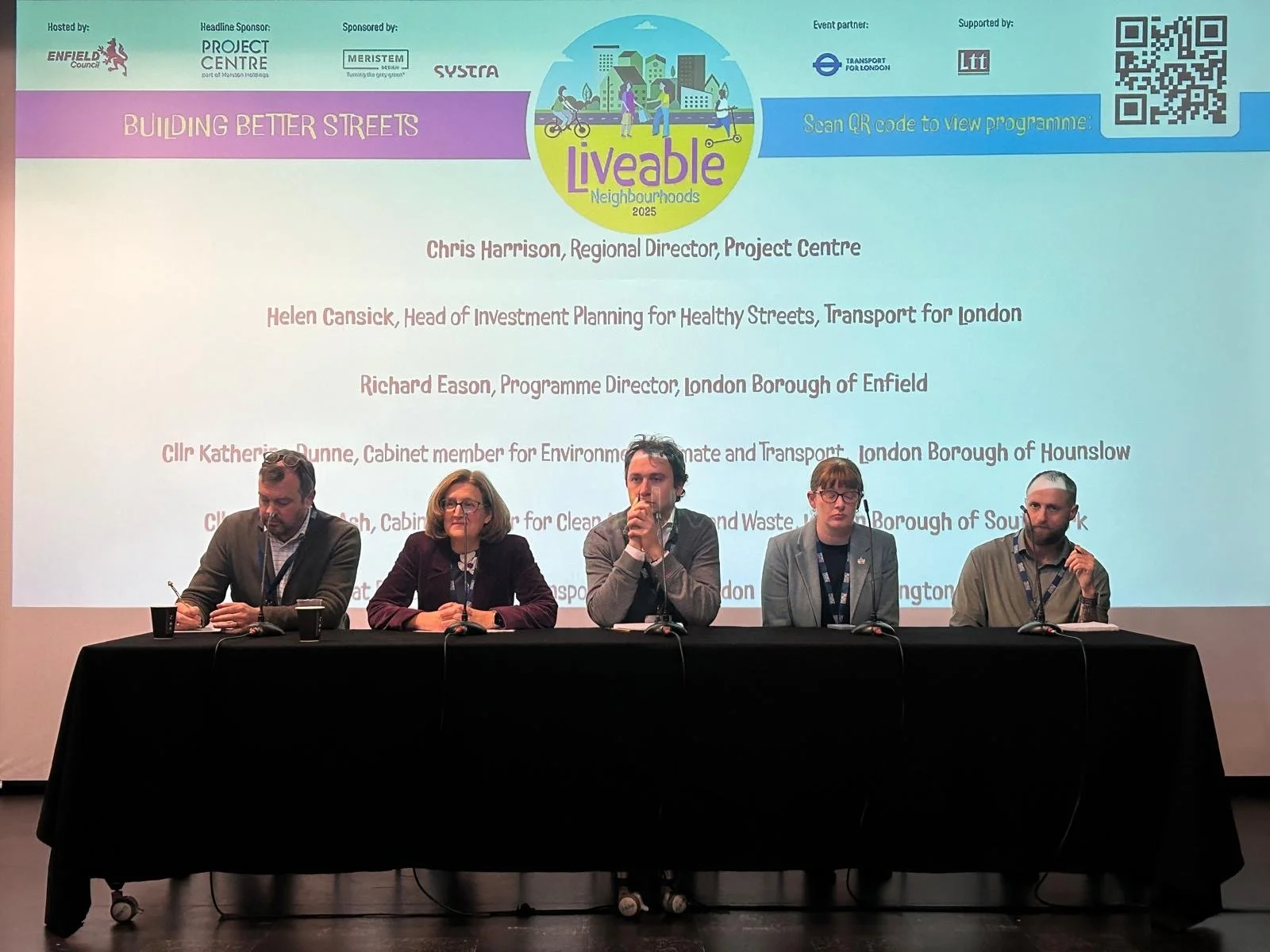
There was also a clear warning: you can “engage to death” and lose momentum. At some point, it’s important to move from ideas to doing – but to do so in a way that feels reversible, learn-as-you-go, rather than all-or-nothing.
The underlying logic was clear: momentum brings confidence and change. Small, visible steps create belief that bigger change is possible. This is systems change in action, one mini-project at a time :)
4. Hearts, minds and narratives in a tough climate
The conference didn’t shy away from the emotional and political reality.
We heard about the toxicity of online debate, the “war on motorists” framing, and the very real intimidation some elected members face. We also heard a strong call to keep coming back to road danger and fairness.
Leader of City Hall (Green Party), Caroline Russell, talked about Vision Zero – the goal of no one being killed or seriously injured on the roads – and how often that gets drowned out:
20mph limits are attacked as a “burden on motorists”, rather than a basic condition for children and older people to cross the road safely.
Safe crossings become “woke pedestrian crossings” , while the daily toll of crashes and near-misses remains strangely invisible.
Another strong theme was honesty about intent. In Southwark, for example, Cllr James McAsh advised being really upfront in conversations:
They ask residents what they want on their street; “unsurprisingly, no one says “more traffic”, says James. “They want safer play, more benches, trees, better air”.
They then explain that to deliver those things, traffic has to come down – be clear that this is the intention. There’s no sugar coating it. And yes, that means some short car journeys will become less convenient. “That’s the trade-off, and we name it” says James.
Engagement, they reminded us, is a two-way process: part listening, part making the case for change. And all of this is happening in a context where “war on motorists” rhetoric and online abuse can make it genuinely hard – and sometimes frightening – to be brave in public office.
For campaigners like OLS, this was both grounding and challenging. It was a salient reminder of the volatility – but also that we can’t avoid the harder conversations about what needs to change, and why. And perhaps signalling a role for us to play in a particularly challenging Oxfordshire landscape, home to “Britain’s most hated bollard”.
Part 2: What this means in practice for Oxfordshire
So what do we do with all of this? What does it suggest for how we work here, in a context that’s already highly charged?
💡For councillors and officers
We heard loud and clear that local authorities are operating under huge pressure, with limited capacity and plenty of scrutiny. Within that reality, a few practical implications stood out:
Treat engagement as core project work. It isn’t a line in the Gantt chart; it is the Gantt chart. Build time and budget for it from the start.
Be explicit about influence. At every stage, make it clear what people can genuinely shape and what’s non-negotiable – and stick to that.
Track who’s in the room – and who isn’t. Use data to see whose voices are missing, then deliberately go to them: schools, community groups, faith spaces, youth spaces, tenant associations, carers, shift workers.
Use experiments and trials to build confidence. Start with visible, bite-sized changes that show what’s possible – and commit up front to learning and adjusting.
Name the trade-offs. Be honest that some car trips will get less convenient, and explain why – in terms of safety, health, fairness and long-term resilience, not just traffic models.
We know many of you are already doing some or all of this, often in challenging circumstances. The conference reinforced that you’re not alone – and that these approaches are working elsewhere.
💡For Oxfordshire Liveable Streets and other civil society groups
We also heard a quieter, but important theme: councils can’t – and shouldn’t – do this work alone. This is where groups like OLS, and the wider civic ecosystem, have a role to play.
We don’t set policy. But we can:
Help surface what communities actually want from their streets, beyond the usual loud voices – especially those who are less likely to show up to formal processes.
Share what we’re hearing – including discomforts and disagreements – back into councils in a constructive way, so it can inform design and decision-making.
Champion the idea that liveable neighbourhoods are about everyday wellbeing, fairness and opportunity, not just transport plans and climate targets.
And, more broadly, we can:
Act as trusted messengers, hosting conversations in spaces where the council might not be present or fully trusted, and helping people navigate complex changes.
Hold onto the bigger story: that this is about streets where no one pays with their life for a simple mistake; where kids can play outside; where older people and disabled people can move around with confidence; where local businesses can thrive on footfall, not just through-traffic.
If there’s one thing the conference made clear, it’s that the depth and breadth of engagement will make or break these schemes. That’s a shared job – and one where civil society can’t sit on the sidelines.
Closing: a tough gig – and a shared job
Creating liveable neighbourhoods is hard work for everyone involved.
For councillors and officers, it means operating under intense scrutiny, managing legal and political risk, and holding the nerves of whole communities as change beds in. For residents and businesses, it means adjusting long-standing habits in the middle of busy lives.
For campaigners, it means trying to hold a hopeful vision in a noisy, sometimes hostile public square whilst creating a bigger story about what “liveable” really means.
At Oxfordshire Liveable Streets, our intention is to be a helpful partner and a critical friend in that mix – not defending what’s happening, but helping to shape how it happens, and whose voices are centred along the way.
On that note, thanks to an extremely generous donation, we have an exciting project in the pipeline for 2026. We’ll be announcing it in our December newsletter.
👉🏽 Sign up to the mailing list here if you haven’t already.